Intro
GEO (generative engine optimization) is still a young concept. Simply said, it's about how companies show up when buyers ask ChatGPT, Gemini, Claude or Google AI Mode what to use. I believe it has huge advertising potential, ChatGPT alone had 900 million weekly users in February 2026, but our current knowledge and understanding of it is still extremely poor. The whole field has only a few dozen studies. A survey from July 2026 counted 45 of them, and found that none of the techniques studied so far shows a stable effect on visibility or traffic across platforms.
I am not a professional researcher, and this research isn't claiming to be an academic study. Still, the field lacks data, so I am doing the best I can. AI tools were used heavily during the creation of this research, both for the paper and for the code. I wrote the analysis plan and my predictions before collecting any data, and I report them as they came out, including the ones that were wrong and the one I couldn't test the way I planned.
The code is open source on GitHub and the data is on Zenodo, so whoever wants can recheck the results themselves. I am open to critique, and to any feedback showing where my approach was wrong or what I missed. The ideas I borrowed, and where they come from, are listed at the end.
This study looks at one market, AI receptionist and voice agent software. Why only one? I believe looking at one niche at a time is the key to successful GEO, because such a screening shows what makes the top companies of that niche appear on top. Just to be clear, this is a different thing from the buyer's industry inside the questions (dental, legal, home services), which turned out to matter less than the engine, see the key findings.
Key findings
- Vendor-written pages are the largest part of what AI cites, 74% to 91% of citations in every engine, while review sites are 0.8% or less.
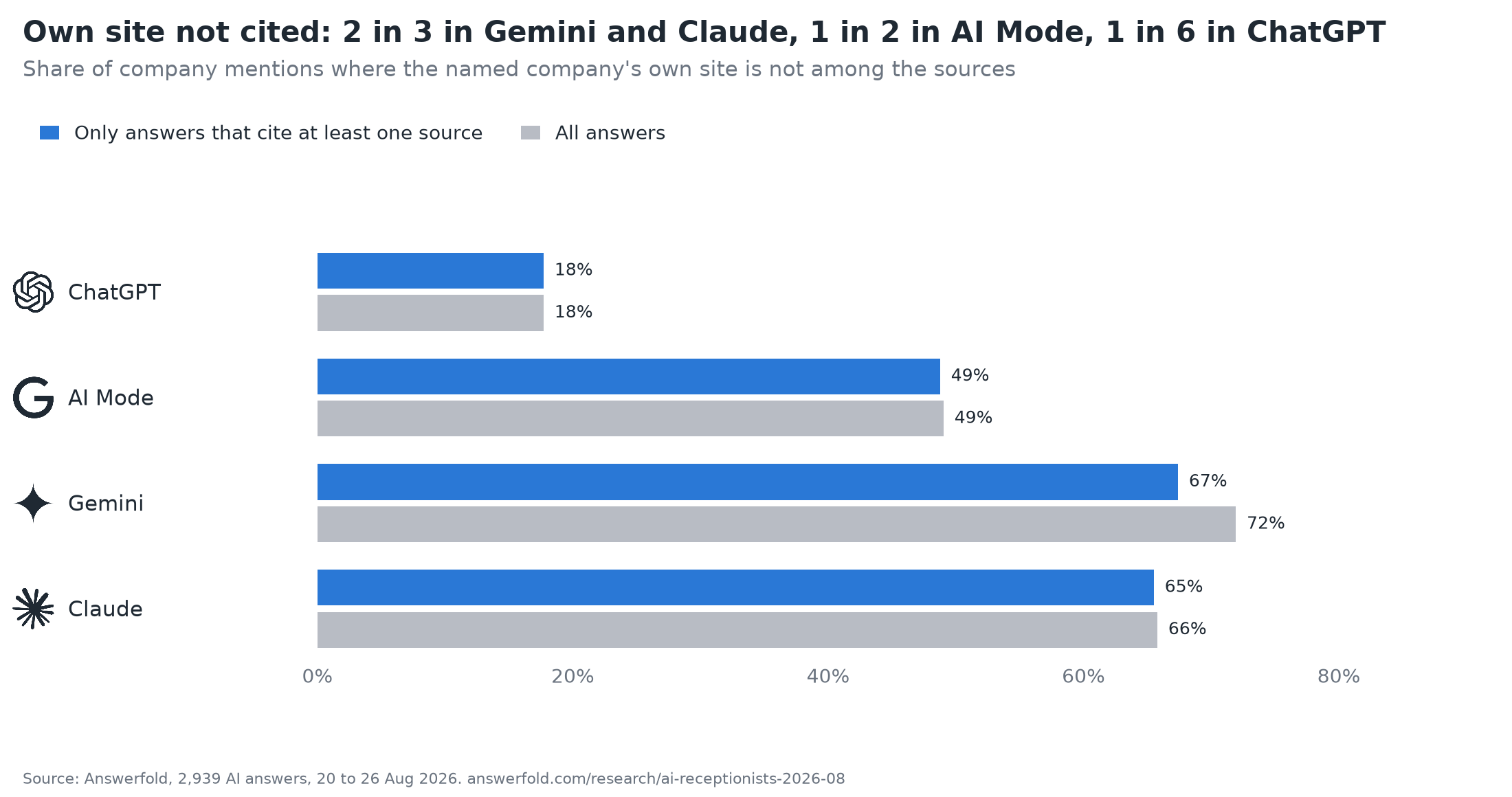
- When an answer cites sources and names a company, its own site is missing from them about 2 in 3 of the time in Gemini and Claude, and less often in AI Mode and ChatGPT.
- 8 to 11 companies get half of all company mentions in each engine.
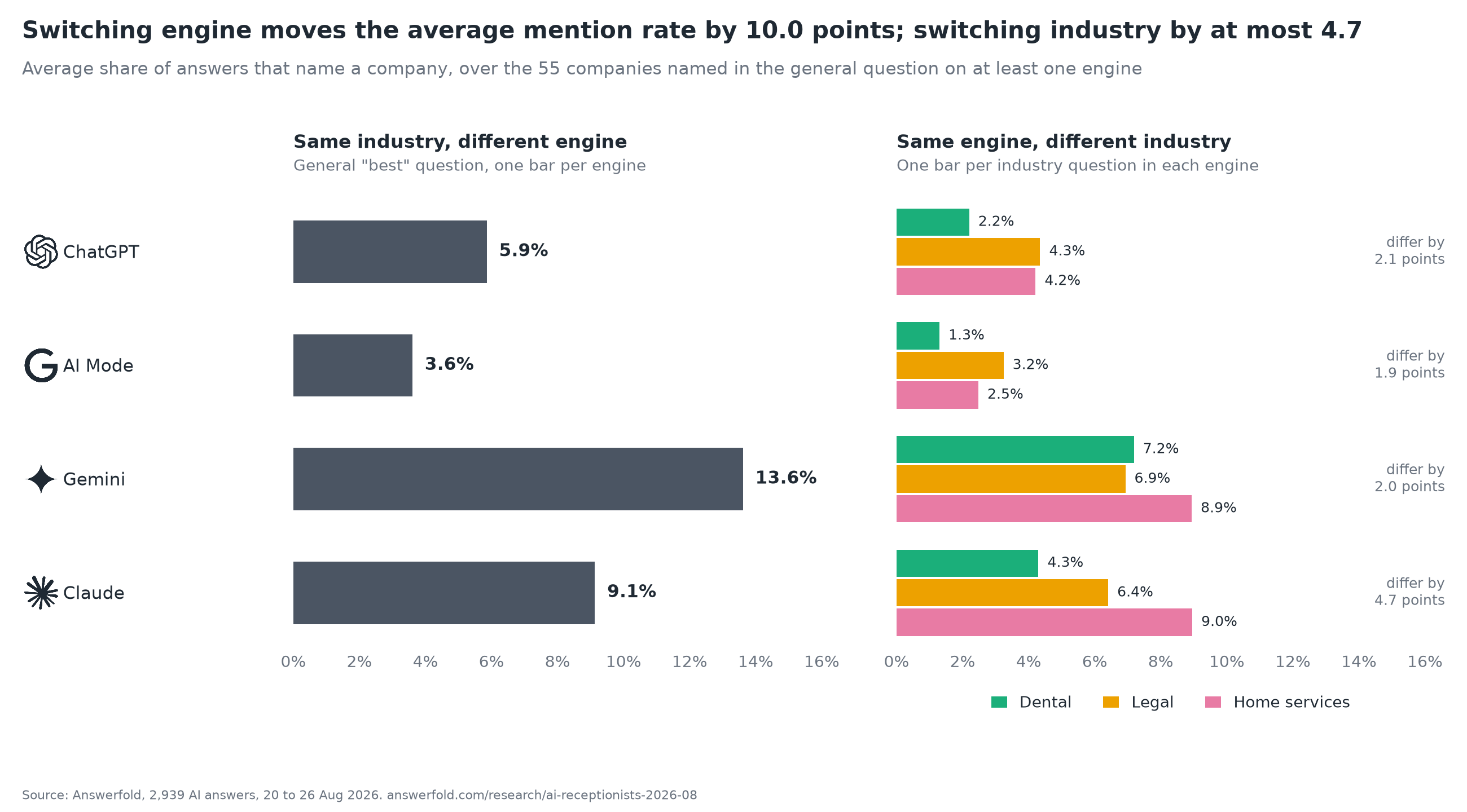
- For the typical company, changing the engine moves its mention rate about 2.2 times as much as changing the industry. We predicted the opposite.
- Reword a question and the answers share only 22% of the companies named, fewer than when you ask it again.
Where AI gets its answers
Pages written by vendors are the biggest source in every engine. We predicted that, and the lowest share, in AI Mode, is still 74%.
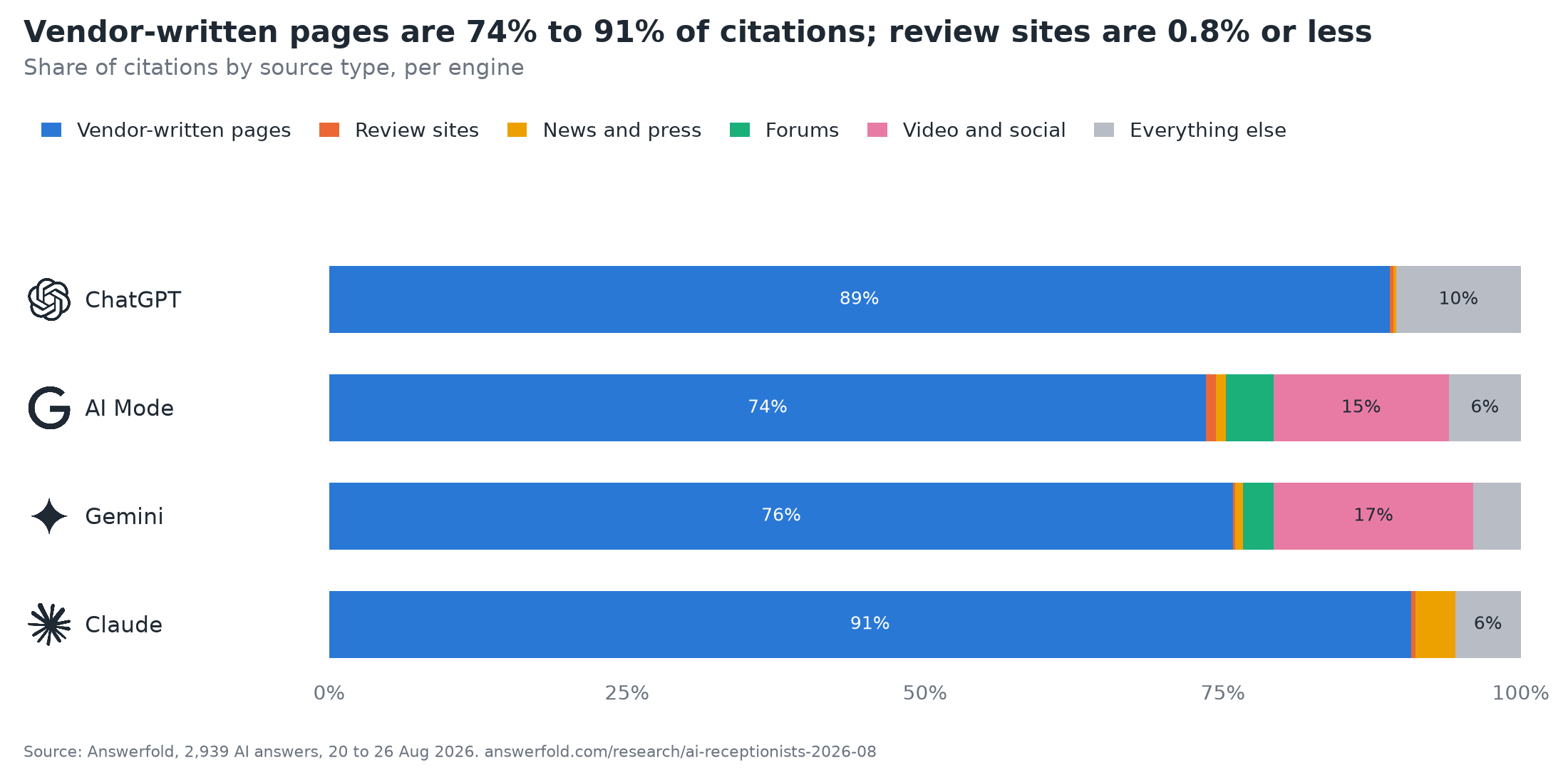
The type of vendor page differs by engine. Product pages lead in ChatGPT and, narrowly, in AI Mode. Vendor "best of" lists lead in Gemini and Claude. In Claude they are 75% of citations.
YouTube is 12% to 17% of citations in AI Mode and Gemini, and 0% in ChatGPT and Claude.
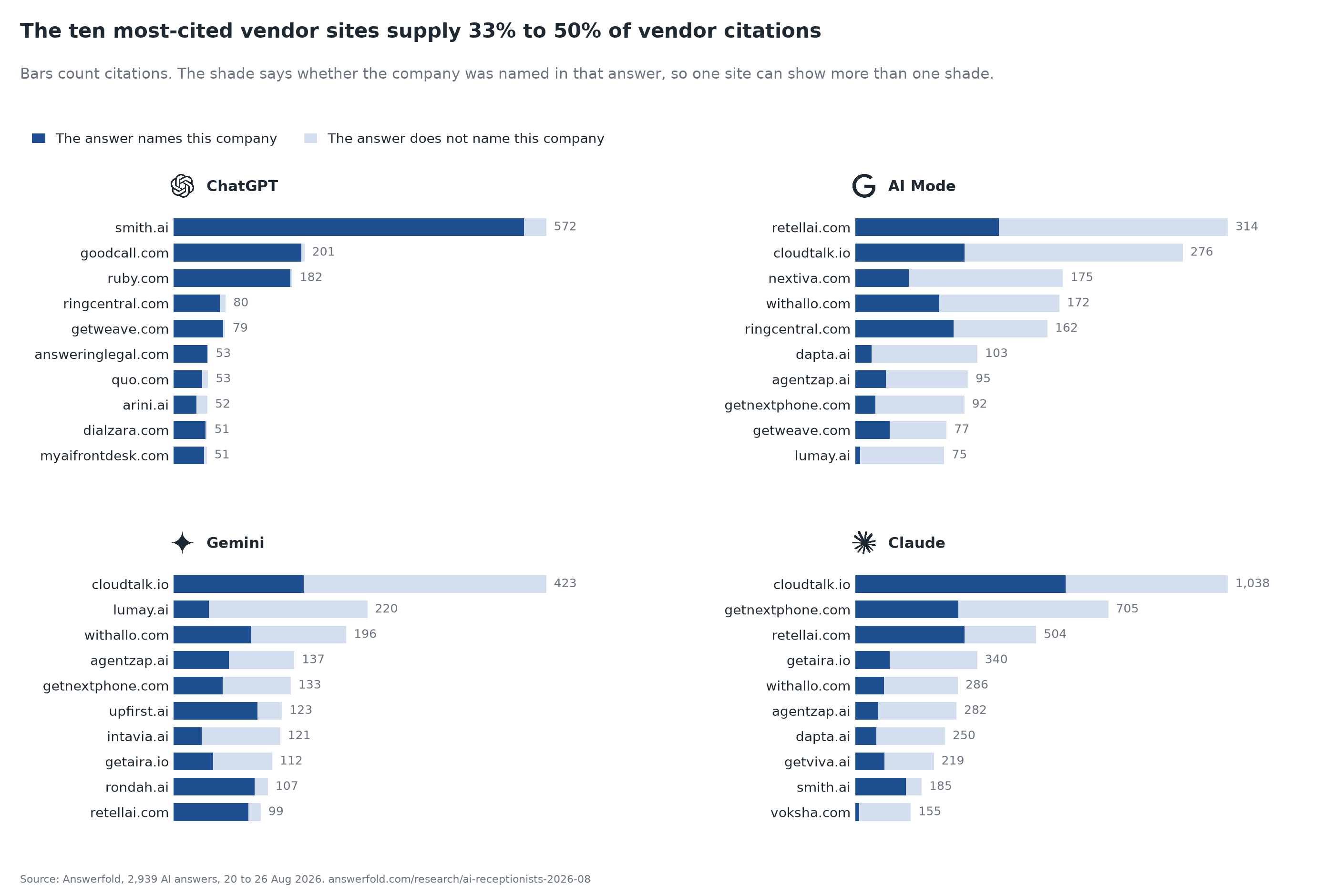
The most cited page in Claude is https://cloudtalk.io/blog/best-dental-ai-virtual-receptionist-tools, with 389 citations. In ChatGPT it is https://smith.ai/ai-receptionist (175). We leave YouTube out of page-level claims, because our data merges every video into a shared address.
No short list of sites carries an engine. The ten most-cited sites together get 38% to 46% of all its citations. Set the sites of every company on our list aside and that share goes up in ChatGPT, AI Mode and Gemini, and down in Claude. Most cited sites outside our company list:
| Engine | Most cited sites outside our company list |
|---|---|
| ChatGPT | americanbar.org, servicetitan.com, housecallpro.com, clio.com, getpearl.ai |
| AI Mode | youtube.com, reddit.com, facebook.com, instagram.com, medium.com |
| Gemini | youtube.com, reddit.com, housecallpro.com, servicetitan.com, attorneyatlawmagazine.com |
| Claude | technology.org, myquoteiq.com, attorneyatlawmagazine.com, embroker.com, mconsent.net |
Named, but not from your own site
In answers that cite sources, Gemini and Claude name a company and leave its own site out of them about 2 in 3 of the time. In AI Mode it is 1 in 2, in ChatGPT 1 in 6. The search fan-out likely explains the gap. We looked at it after the data was in, and the source is in the appendix. ChatGPT runs 7.1 searches per answer, and 53% are limited to a vendor's own domain. Gemini runs about 1.6 plain searches. For the question "best AI receptionist", Gemini searched "best AI receptionist 2025 2026" and ChatGPT searched "site:goodcall.com pricing AI receptionist". We did not test this, and AI Mode does not keep its searches.
A few companies take half of mentions
Half of all company mentions go to 8 to 11 companies in each engine, out of the 120 to 207 companies on our list that each engine named. The top five alone get 31% to 44%.
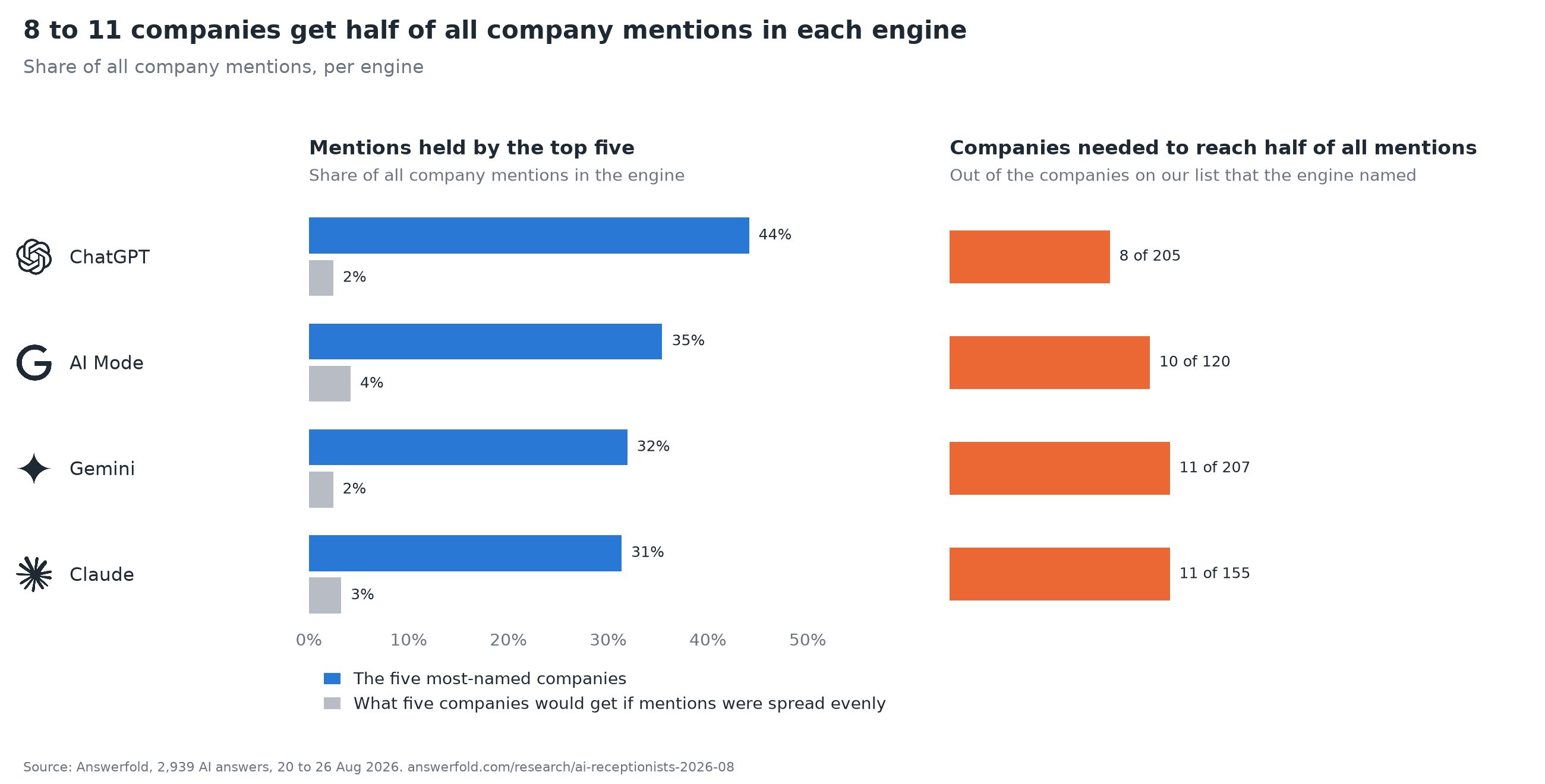
- ChatGPT: Smith.ai, Ruby, Goodcall, Answering Legal, Dialzara.
- AI Mode: Smith.ai, CloudTalk, Retell AI, Allo, Rosie AI.
- Gemini: Smith.ai, Retell AI, Synthflow AI, Bland AI, Vapi.
- Claude: Smith.ai, CloudTalk, Dialzara, Goodcall, Rosie AI.
The engine matters more than the industry
We predicted the opposite, and we were wrong. We expected a company's mention rate to move more with the industry. For the median company, the industry spread is 0.46 times the engine spread. The engine matters more for 42 of the 55 companies we could compare.
It also holds without the runs where the engine skipped the web search. With those 128 runs removed, the median ratio is 0.47, and the engine matters more for 37 of 51 companies.
Google ranking goes with being named
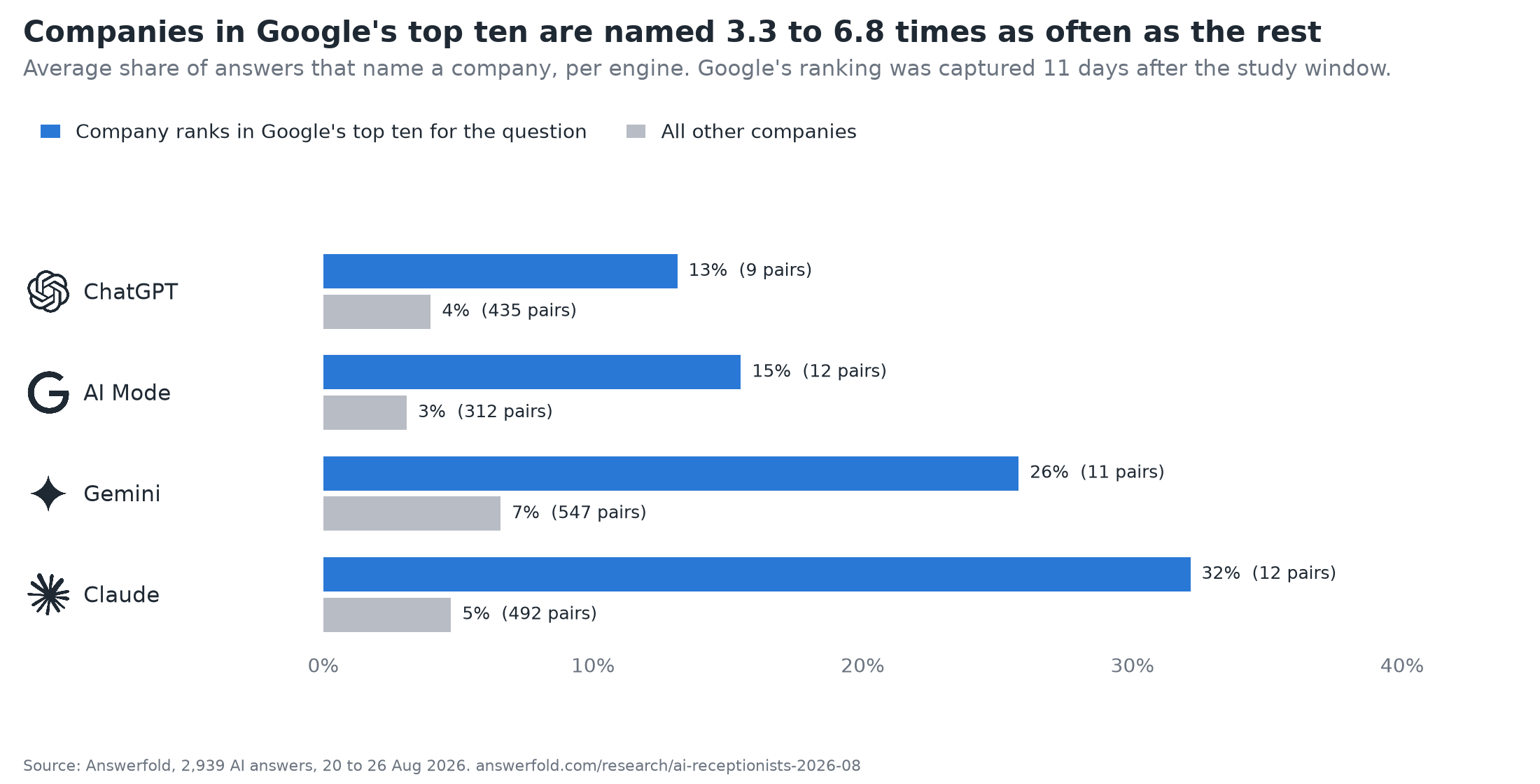
Companies in Google's top ten are named 3.3 to 6.8 times as often as the rest. That is a correlation: ranking goes with being named, and we cannot say it causes it. Google's top ten was captured 11 days after the window. The test we planned was untestable as planned. The groups are small, 9 to 12 pairs per engine.
How to measure AI visibility
- Reword, do not only repeat. Reword a question and the answers share 22% of their companies. Ask it again and they share 35%.
- Day-to-day gaps look like chance. The differences between days are what chance alone produces. Gemini's top group overlaps 80.5% between neighbouring days, just at the 80% line, but its tail overlaps 66%. No engine shows a stable top group together with a churning tail.
- The typical company does not drift. The median change is 0.0 percentage points, and only 0.9% to 2.4% of cases move enough to alert on.
- Engines do not move together. The average correlation between pairs of engines is -0.07, and none reaches 0.3. Check each engine on its own.
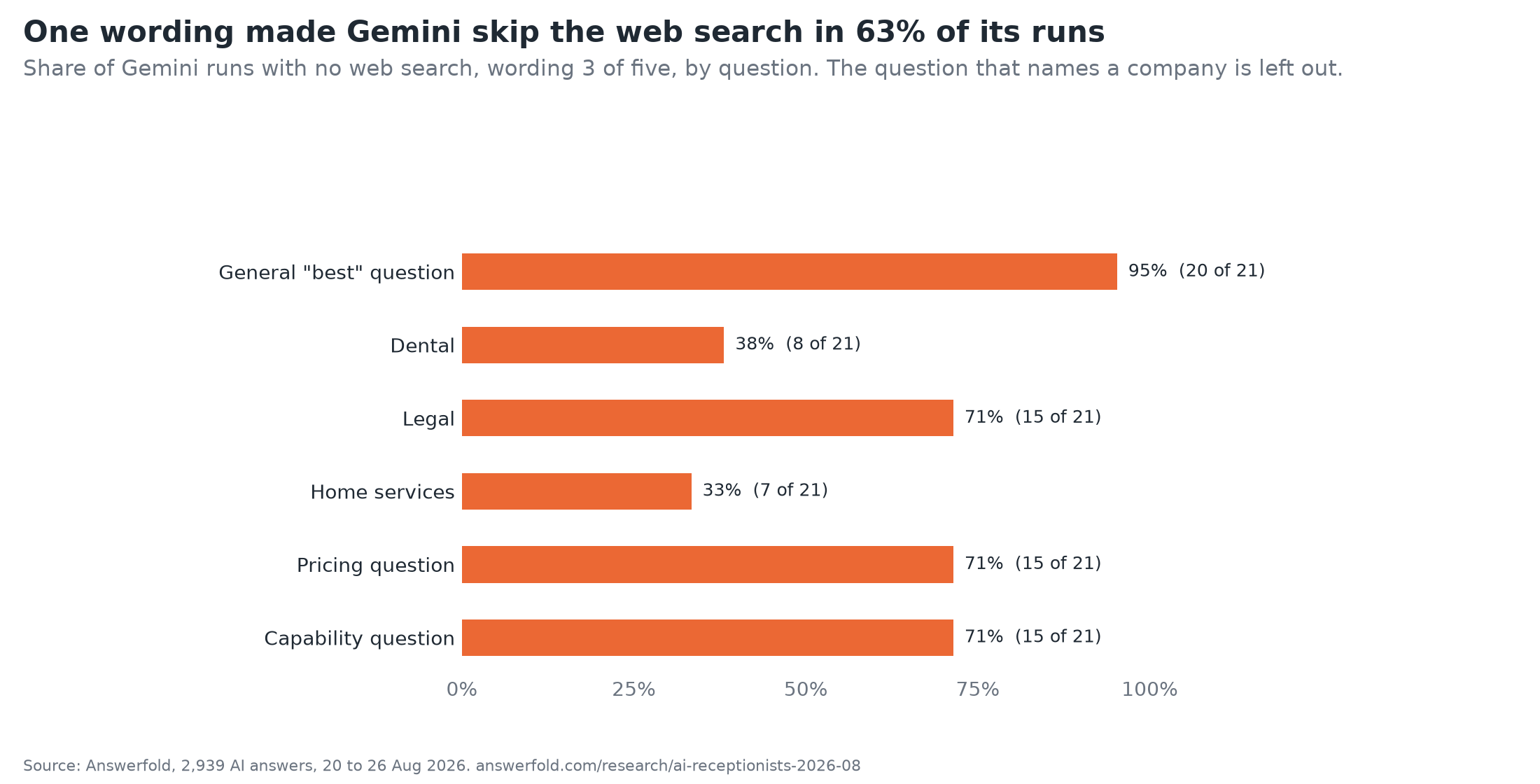
- A wording can switch search off. On the unbranded questions, a particular wording made Gemini skip the web search in 63% of its runs. We found this after the data was in. 80 of Gemini's 109 no-search runs came from this wording. The wording was "is there any way to stop missing calls for our company, what tool should we use?" With no search, no page can be cited.
What the data suggests you do
These are suggestions from correlational data, not tested causes.
- Publish your own comparison and "best of" pages. Vendor lists lead in Gemini and Claude. In Claude they are 75% of citations.
- Get into other vendors' and partners' lists. Your own site is left out of the sources 2 in 3 of the time in Gemini and Claude.
- Keep clear product pages for ChatGPT, where product pages are 89% of citations.
- Consider YouTube for the Google engines, where it is 12% to 17% of citations.
- Review sites look like a weak lever here: they are 0.8% or less of citations.
- Keep investing in search ranking. Google's top ten companies are named 3.3 to 6.8 times as often.
- Measure across several wordings and over several days. Rewording changes the named companies more (22% shared) than asking again (35%).
Method
- Engines and the model each returned: ChatGPT (gpt-5.6-luna); AI Mode (no model name returned, collected through a scraper); Gemini (gemini-3.6-flash); Claude (claude-sonnet-5). All four engines were queried with the location set to the United States, and the questions were in English.
- Design: 7 questions x 5 wordings x 3 runs a day x 7 days, 735 planned runs per engine and 2,940 in all. Answers were collected 20 to 26 August 2026.
- 2,939 runs were usable. Runs lost to a collection error: 1.
- The company list holds 415 in-scope companies found in the answers. A company counts for an engine when it is named at least 5 times there: 74 in ChatGPT, 54 in AI Mode, 93 in Gemini and 84 in Claude. The answers also named 530 brands outside the scope.
- Broad phone platforms (RingCentral, Nextiva, Weave, Dialpad, Aircall, Quo, CallRail) and ElevenLabs fall outside our company list because their main product is not an AI receptionist or voice agent. Their pages still count as vendor pages in the source charts.
- App check: 30 hand runs in the ChatGPT and Gemini apps. 80 of the 101 companies named in the apps were also named in the API data.
- Deviations: Google's top ten was captured 11 days after the window, and the app check 3 days after.
- On 2026-10-12, eight company labels that broke the frame's own rules were run again with the unchanged classifier. Where it again returned an invalid label (six of the eight), we decided the label by hand against the frame, and we set one more by hand because its homepage was blank. The change was logged and all figures were recomputed.
- The analysis plan and predictions were written before collection. The rules for which companies count were fixed on 2026-09-05, after collection.
- Full numbers and every chart: the appendix.
What we predicted vs what we found
- Vendor pages are the largest source type: held in all four engines, above the 55% line, with 74% as the lowest share.
- Industry moves a company's rate more than the engine: wrong. The median ratio is 0.46 against a planned line of 1.0.
- Google's top ten predicts mentions: untestable as planned. No question met the 20% to 80% top-ten rule, so we show the gap instead, 3.3 to 6.8 times.
- A stable top group with a churning tail: a stable top group together with a churning tail appeared in no engine. Gemini's top group alone reaches 80.5%, just at the 80% line, but its tail is 66%.
Conclusion
So what does it show? Mostly that there is a lot of leverage. In this market AI answers are built mostly from pages vendors write about themselves and about each other, 74% to 91% of the citations, and half of all mentions go to just 8 to 11 companies in each engine. In Gemini and Claude a company is usually named without its own site among the sources, so what others write about you matters as much as what you write yourself. All of these pages can be written and changed, that's why I think the room to move is big. Still, I have to be honest, this is correlation, I didn't test what happens when a company actually changes something.
It also slightly differs from the main SEO and GEO advice. Google says GEO is still SEO, and partly the data agrees: companies in Google's top ten get named 3.3 to 6.8 times as often. But a lot of the usual tips, like getting reviews or being on Reddit, don't show up much here, at least in this market. Review sites are 0.8% of citations or less and Reddit is 3.8% or less. And the engine you ask matters more than the industry, so each engine needs to be checked on its own, and classic SEO advice doesn't really cover that.
For now it's hard to track what GEO actually brings in money. AI sends only a small part of website traffic, and studies give quite different numbers, 0.32% of visits in one and about 1% in another, but that share keeps growing every year. So further research is needed, especially tests where a company changes something and we measure before and after, to know which changes are really worth it for business.
If you have feedback, found a mistake, want to cooperate, or want to know how your market looks, write me at danylo@answerfold.com. I also do per company breakdowns: how your company shows up in each engine, which pages AI reads when it names your competitors, and a plan to improve your visibility based on what the most named companies in your market do.
What I built on
- GEO itself, the idea that AI answers can be measured and influenced: Aggarwal et al., GEO: Generative Engine Optimization, KDD 2024.
- Counting how often a company is named, not its rank, because the same question almost never gets the same list twice: Rand Fishkin (SparkToro) and Patrick O'Donnell (Gumshoe), research on AI answer consistency, January 2026.
- 5 wordings for every question: Jack, Lehman, Maloney and Xu, Paraphrase Brittleness in Production Retrieval-Augmented Commercial Recommendation, 2026. The key findings show the same thing here: rewording changes the answer more than asking again.
- Spending runs on wordings, not on repeats: Zatuchin, Where Does the Noise Come From?, 2026.
- 3 runs a day for 7 days, to tell run-to-run noise apart from real day-to-day change. Schulte, Bleeker and Kaufmann (Don't Measure Once, 2026) suggest at least 7 runs of a prompt per day. I did 3 per wording, because the two papers above suggest that extra wordings help more than extra repeats.
- Plan and predictions written before the data: borrowed from pre-registration in science, Nosek et al., The preregistration revolution, PNAS 2018. Mine is a lighter version.
- Query fan-out, the extra searches an engine runs behind one question: Google's own term, explained in its guide on AI search.
- Overlap between answers: the Jaccard index, companies named in both answers divided by companies named in either.
Several of these come from people who work at companies in the AI visibility business (Gumshoe, Unusual, Rankfor.AI, Aurora Intelligence). So do I, with Answerfold, so read all of us with that in mind.
Questions about the data? danylo@answerfold.com