We asked four engines: OpenAI ChatGPT, Google AI Mode, Google Gemini and Anthropic Claude. From here on we call them ChatGPT, AI Mode, Gemini and Claude.
Intro
GEO (generative engine optimization) is still a young concept. Simply said, it's about how companies show up when buyers ask ChatGPT, Gemini, Claude or Google AI Mode what to use. I believe it has huge advertising potential, ChatGPT alone had 900 million weekly users in February 2026, but our current knowledge and understanding of it is still extremely poor. The whole field has only a few dozen studies. A survey from July 2026 counted 45 of them, and found that none of the techniques studied so far shows a stable effect on visibility or traffic across platforms.
I am not a professional researcher, and this research isn't claiming to be an academic study. Still, the field lacks data, so I am doing the best I can. AI tools were used heavily during the creation of this research, both for the paper and for the code. I wrote the analysis plan and my predictions before collecting any data, and I report them as they came out, including the ones that were wrong and the one I couldn't test the way I planned.
The code is open source on GitHub and the data is on Zenodo, so whoever wants can recheck the results themselves. I am open to critique, and to any feedback showing where my approach was wrong or what I missed. The ideas I borrowed, and where they come from, are listed in the last section, "What I built on".
This study looks at one market, AI receptionist and voice agent software. Why only one? I believe looking at one niche at a time is the key to successful GEO, because such a screening shows what makes the top companies of that niche appear on top. Just to be clear, this is a different thing from the buyer's industry inside the questions (dental, legal, home services), which turned out to matter less than the engine, see the summary page.
1. The result at a glance
- Whether a company's own website is among the sources when the company is named depends on the engine. In answers that cited any source, the company's own site was missing from about 2 in 3 of the mentions in Gemini and Claude, about 1 in 2 in AI Mode and about 1 in 6 in ChatGPT.
- A few companies take a large part of every engine's mentions. Between 8 and 11 companies account for half of all company mentions in an engine, out of 120 to 207 companies the engine named.
- Vendor-published pages are the largest type of cited source in every engine, between 73.6% and 90.8% of classified citations.
2. Method
We put the same fixed buyer questions to four AI engines. AI Mode was reached through a scraper, not directly through an API as the other engines were, so it is not directly comparable with the API engines. All four engines were queried with the location set to the United States, and the questions were in English.
- Questions. The study used seven buyer questions: General "best" question; Dental; Legal; Home services; Pricing question; Capability question; Question that names a company. The question that names a company is reported apart. Every company statistic uses only the six questions that do not name a company.
- Wordings. Each question was asked in five different wordings.
- Runs. Each wording was run three times a day for seven days, from 2026-08-20 to 2026-08-26.
- Planned runs. 2,940 in all, 735 for each engine.
- Usable runs. 2,939. Planned runs that were not usable: 1.
- Coded runs. 2,790 usable runs had a company mention extracted from the answer (2,589 named a company on our list, 201 named only companies outside it). The other 149 usable runs named no company.
- Company list. 415 companies, discovered from the answers and bounded by an inclusion frame.
- Eligibility. A company enters a per-company statistic only if an engine named it at least 5 times across the six questions that do not name a company. Companies that qualify: 74 in ChatGPT; 54 in AI Mode; 93 in Gemini; 84 in Claude.
The analysis plan and predictions were written before collection. The rules for which companies count (the inclusion frame) were fixed on 2026-09-05, ten days after the window closed (2026-08-20 to 2026-08-26), so the list of companies was decided after the data was collected.
On 2026-10-12, eight company labels that broke the frame's own rules were run again with the unchanged classifier. Where it again returned an invalid label (six of the eight), we decided the label by hand against the frame, and we set one more by hand because its homepage was blank. The change is in the project's ambiguity ledger, and every figure was recomputed afterwards.
No number is pooled across engines unless a sentence says so. Each engine is read on its own.
How closely the API matches what a person sees
Most of the companies a person sees in the web app were also named by the API: 80 of 101 across both engines, 42 of 53 in Gemini and 38 of 48 in ChatGPT. Both engines also have web-app companies the API never named: 21 in all.
The study collected its answers through each engine's API, not through the web app a person types into. To see how closely they match, we ran five of the buyer questions by hand in the web apps of two engines. Each question was run three times in each web app, 30 runs in all. We counted the companies those runs named and how many of them the API runs for the same question also named. The API side is the study window itself, 21 runs per question and engine.
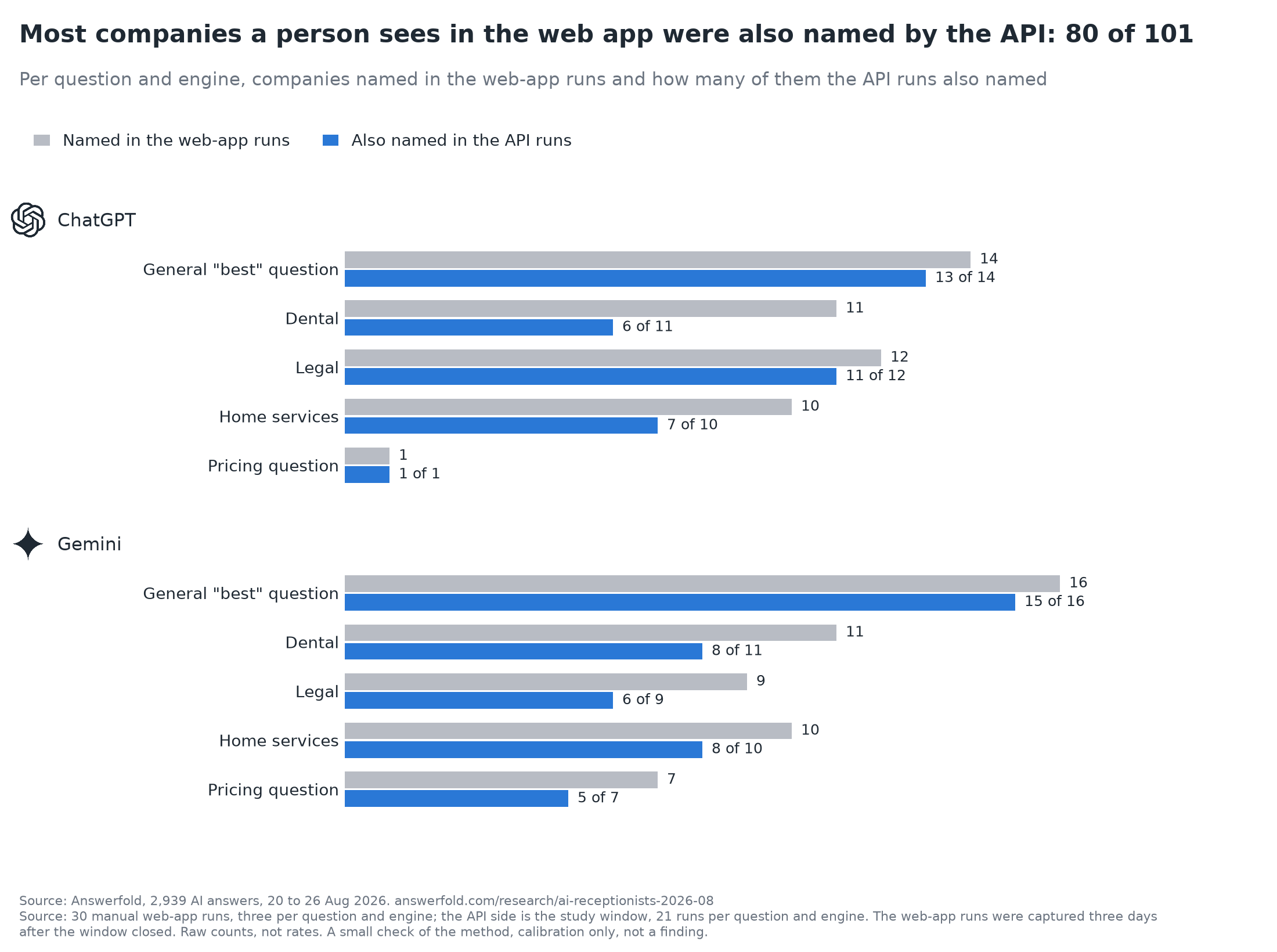
This is a small check of the method, with raw counts and no rates. We captured the web-app runs three days after the window closed, and only two of the engines were checked this way. It tells you how far to trust the API view. It says nothing about how AI search behaves.
3. The main questions: sources, Google ranking and industry
Who writes what AI search cites [S1]
Vendor-published pages are the largest source type in every engine, between 74% (AI Mode) and 91% (Claude) of classified citations. We predicted this before collection, and it held: in all four engines the share is above the planned line of 55%. The rest is spread across other company sites, forums, news, video and social platforms, and review sites.
We put the same buyer questions to the engines 3 times a day for 7 days and recorded every web page each engine cited. Each cited page is a citation. A page cited in several answers counts each time. The charts below count only questions that do not name a vendor, and only citations whose publisher we could classify: 3,066 for ChatGPT, 6,366 for AI Mode, 5,927 for Gemini, 9,086 for Claude.
Who is cited, by type of publisher
The whole bar is all the citations an engine gave, split by the type of website that published the cited page. Segments under 4.5% are left unlabelled. The legend runs from the type cited most overall to the type cited least. The types:
- Vendor-published: a page on the website of a company that sells AI receptionist or voice-agent software, whether a product page, a blog post or a comparison article on its own site.
- Video and social: mostly YouTube, plus Instagram, Facebook, LinkedIn and similar.
- Other company sites: websites of businesses that are not AI receptionist vendors, such as agencies, answering-service firms and business-data sites.
- Forums: Reddit, Quora, Stack Exchange and similar discussion sites.
- News and press: news sites, trade magazines and press-release services.
- Regulators, legal and standards bodies: government agencies, bar associations and professional bodies.
- Review sites: software review and comparison directories.
- Blogs and publishing platforms: Medium, dev.to, GitHub and personal blogs.
- Other: anything left over that fitted none of the types above.
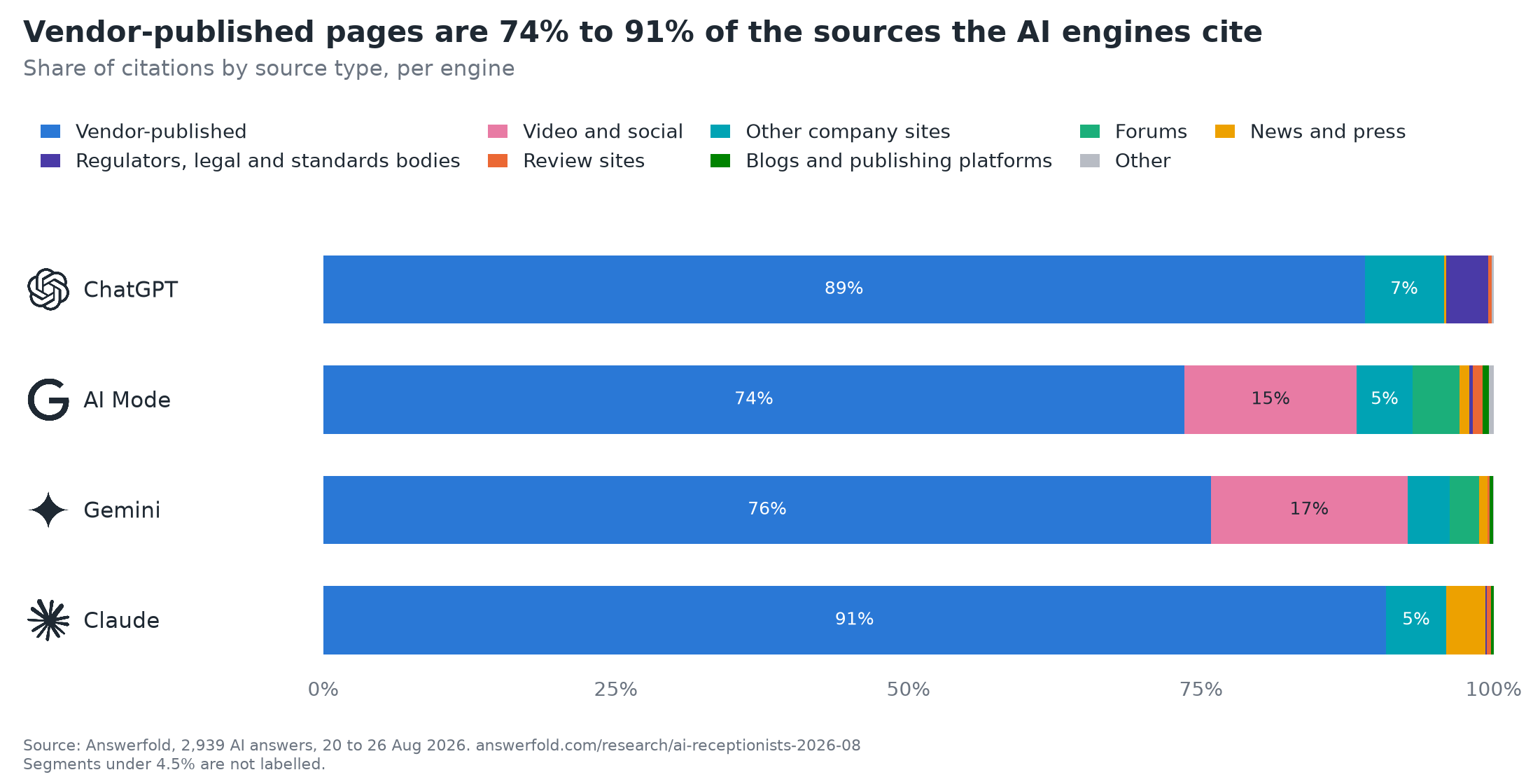
- The Google engines lean on video and social platforms (14.7% in AI Mode, 16.8% in Gemini) and, to a lesser degree, forums (4.0% and 2.6%). ChatGPT and Claude cite neither.
- Little is left unclassified: at most 0.42% of citations (AI Mode) fall in the leftover "Other" group.
- YouTube is 12% to 17% of citations in the Google engines, and Reddit is at most 3.8% of them.
Which vendor domains are cited most
This zooms into the vendor-published part of the chart above. For each engine it lists the ten websites (domains) that supply the most vendor-published citations. Bar length is the number of citations. The shade says whether the company was named in that answer. Dark means the answer names that company. Light means the answer does not name it. This holds for every vendor shown, whether or not it is on our list. A site can show more than a shade when it is cited in some answers that name the company and in others that do not. These are websites, not answers: a site can be cited many times by the same engine.
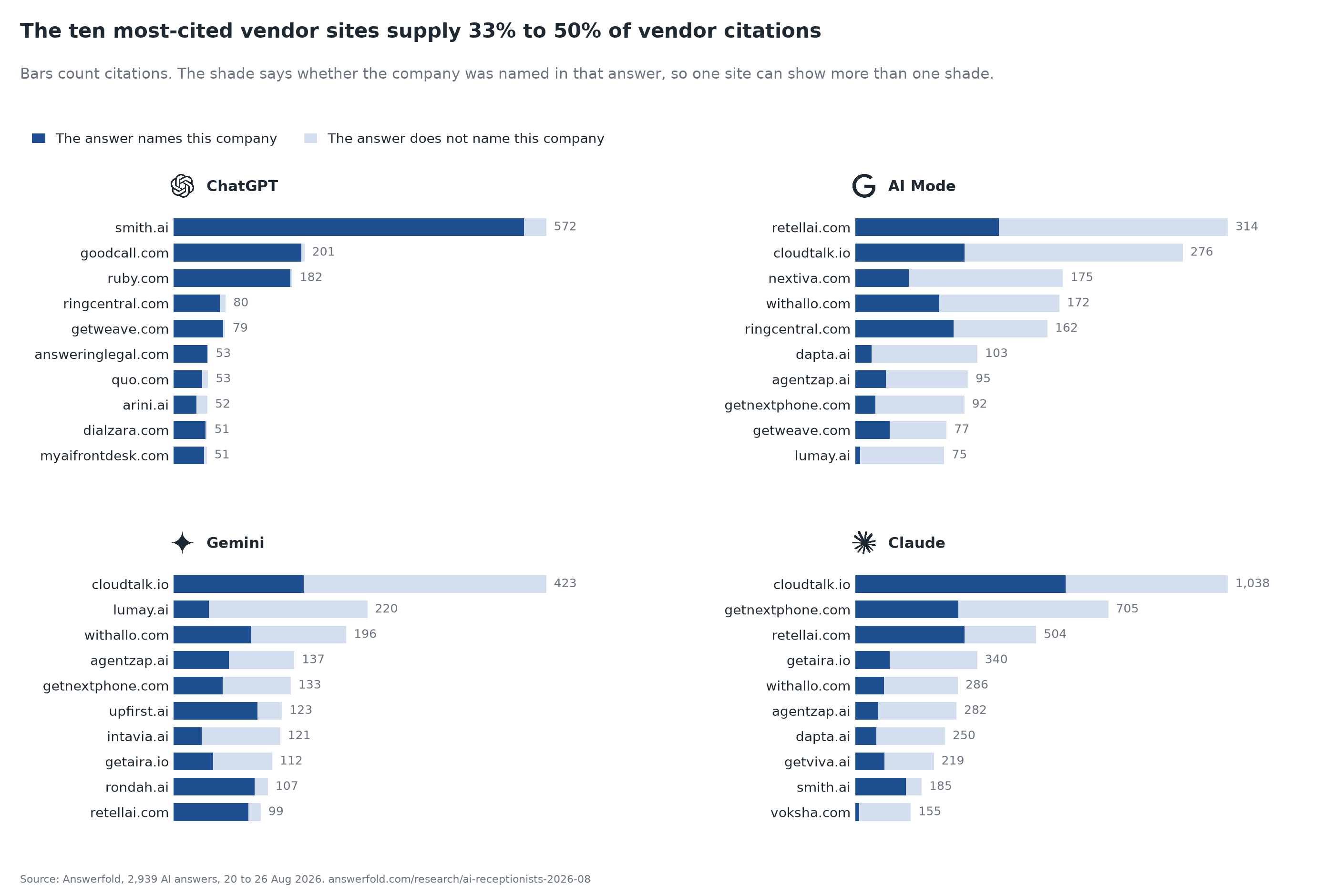
- Citations spread over many distinct vendor domains: 291 in ChatGPT, 418 in AI Mode, 407 in Gemini, 235 in Claude. The 10 most cited domains account for 50%, 33%, 37% and 48% of vendor-published citations in those engines, in that order.
- The leader differs by engine: smith.ai (572 citations) in ChatGPT, retellai.com (314 citations) in AI Mode, cloudtalk.io (423 citations) in Gemini, cloudtalk.io (1,038 citations) in Claude.
Counting pages instead of citations
A page that is cited again and again weighs more in the shares above. If each distinct page is counted on its own, vendor-published pages are 77% to 88% of the distinct pages an engine cited: 84% in ChatGPT; 77% in AI Mode; 86% in Gemini; 88% in Claude. Set against the vendor share of all citations, the page share is higher in AI Mode and Gemini and lower in ChatGPT and Claude, where the same vendor pages are cited again and again. The vendor lead holds either way.
The most cited page in Claude is https://cloudtalk.io/blog/best-dental-ai-virtual-receptionist-tools, with 389 citations. In ChatGPT it is https://smith.ai/ai-receptionist (175). In the Google engines the top address is YouTube, but our data merges every video into a shared address, so that entry is many videos and not a page. We leave YouTube out of page-level claims.
How often vendors are cited on their own pages
Only vendor-published citations are counted here, and the whole bar is all of them for that engine. Each citation is sorted by whose content it is:
- Own page of a company named in the answer (dark blue): the cited page is on the website of a company that the same answer mentions by name.
- Own listicle or blog on such a company's domain (mid blue): the same, but the page is a comparison or "best tools" style article, as labelled by our classifier.
- Vendor content of a company not named in the answer (light): the page belongs to a vendor the answer did not mention.
"Named in the answer" means the company appears by name in the answer text. The own-page and own-listicle parts together are what we call self-reference.
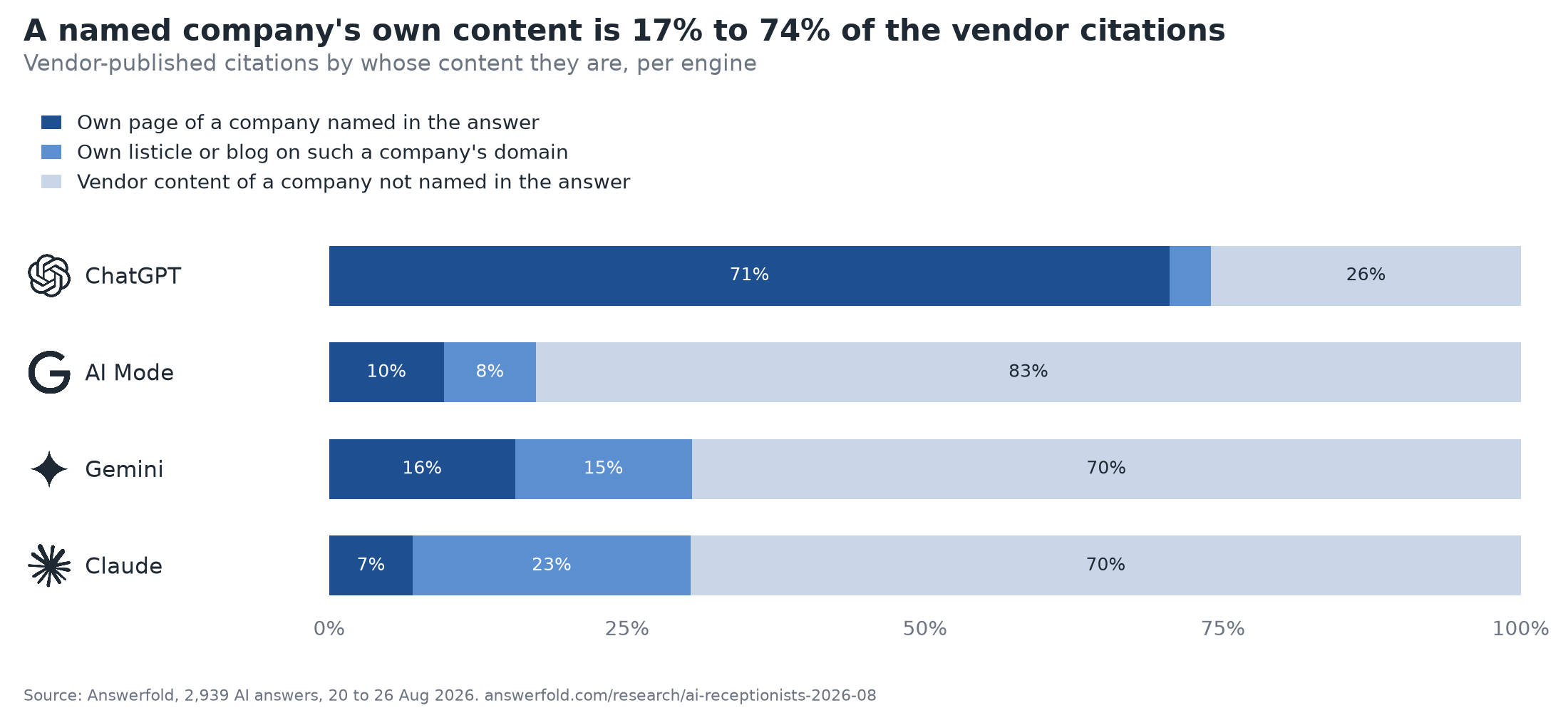
- ChatGPT leans most on a named company's own content: 74% of its vendor-published citations are to the named vendor's own page (71%) or own listicle or blog (3%). The rest are other vendors' pages.
- In the other engines the share is lower: 17% in AI Mode, 30% in Gemini and 30% in Claude. Most of their vendor citations go to a different vendor than the vendor the answer names.
- The top ChatGPT domain, smith.ai, is almost entirely self-reference (538 of 572 citations).
Notes on the method
- "Vendor-published" follows the study's definition for this question. The other types are a plain-language regrouping of all remaining citations, made after collection with a fixed list of websites. They do not change the vendor-published share.
- Citations whose publisher could not be classified are left out of the counts.
Does ranking in Google's top 10 go with being named by AI engines? [A1]
We planned a test of this, and it could not be run as planned. A question only counted if between 20% and 80% of the qualifying companies ranked in Google's top 10 for it. 0 questions met that rule in any engine. The planned correlation (a point-biserial r) could not be computed, and its stored values are empty.
What we show instead is descriptive. In every engine, companies that rank in Google's top 10 for a question are named more often than the other companies: between 13% and 32% of answers, against 3% to 7% for all others.
For each buyer question we recorded which companies appeared in Google's top 10 results. A pair is a company together with a question. The top-10 group is small, between 9 and 12 pairs per engine, against 312 to 547 pairs in the other group. Each engine has a blue bar for the top group and a grey bar for all other companies, and the number of pairs is printed next to each.
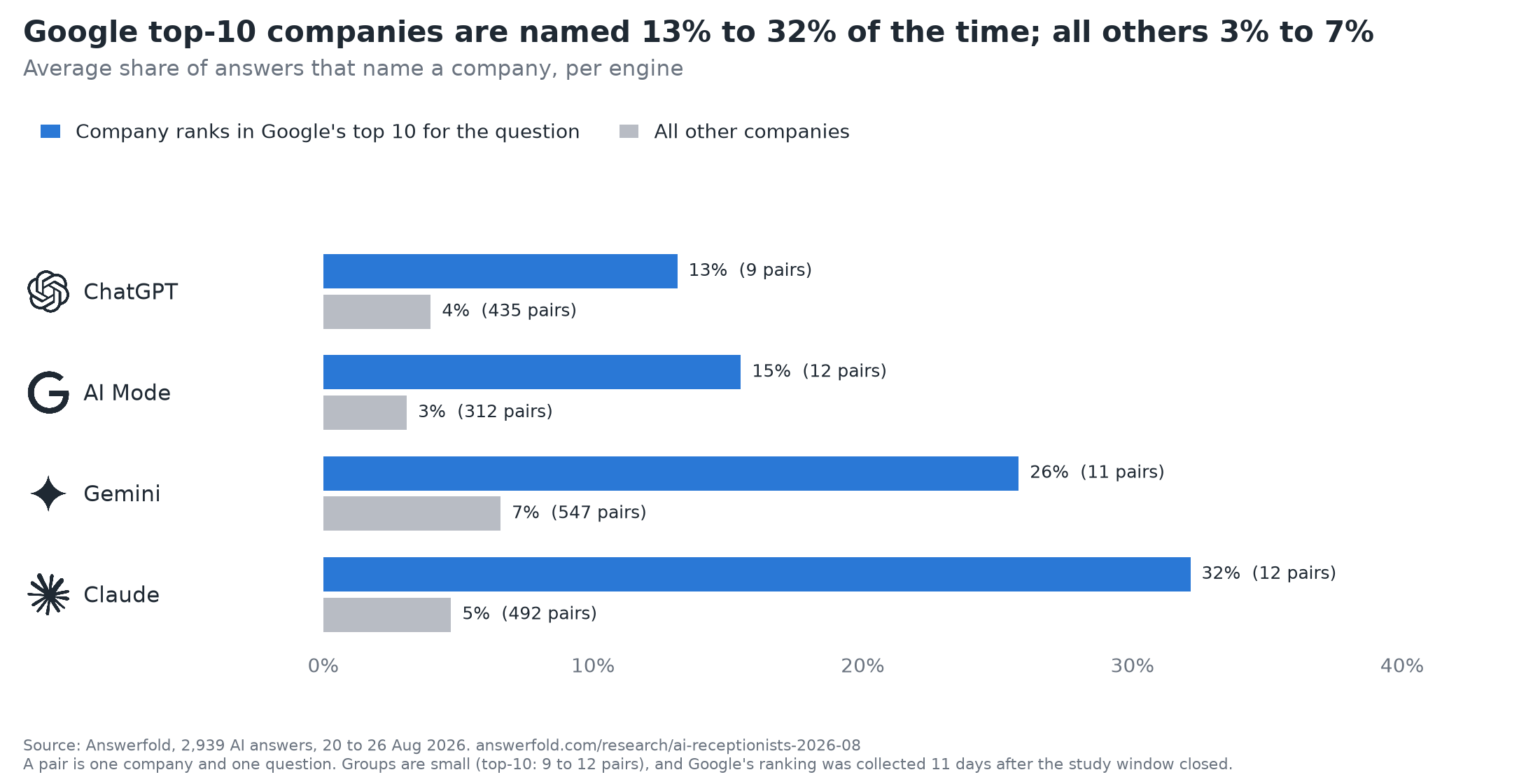
- The gap is widest in Claude, where a top-10 company is named 6.8 times as often as another company, and narrowest in ChatGPT, at 3.3 times.
Notes on the method
- The comparison shows that ranking and being named go together. It does not show that either causes the other. Big brands tend to rank on Google and get named by AI for the same reasons.
- The top-10 groups are small, and Google's ranking was collected 11 days after the study window closed, so the exact percentages are rough and may differ from the ranking buyers saw during the window.
- The share of answers is counted over usable runs of the unbranded buyer questions.
Does the engine or the industry change whether a company is named? [V1]
We predicted that the industry would move a company's mention rate more than the engine does. That was wrong, and the data does not support it. For the typical (median) company, the industry spread is 0.46 times the engine spread. We would have called the prediction supported at 1.5 or more, and rejected it at 1.0 or less.
The result does not depend on the runs where an engine skipped the web search. Without those 128 runs, the median ratio is 0.47, and the engine matters more for 37 of 51 companies.
For 42 of the 55 companies that the engines named at all in the general question, which engine you ask changes how often the company is named more than which industry you ask about does. For 13 the industry matters more.
We asked four AI engines the same general "best" question, and a question for each of three industries: dental, legal and home services. Engine spread is how far apart a company's mention rate is between the four engines on the general question. Industry spread is how far apart it is between the three industries, averaged over the engines. The study has 158 companies that some engine named at least 5 times. 103 of them were never named in the general question on any engine, so their engine spread is zero and they cannot be compared.
Does the engine or the industry move the rate more?
A bar holds all companies, split into three parts:
- The engine matters more (orange): the company's mention rate varies more across engines than across industries.
- The industry matters more (purple): it varies more across industries than across engines.
- Never named in the general question (grey): not compared.
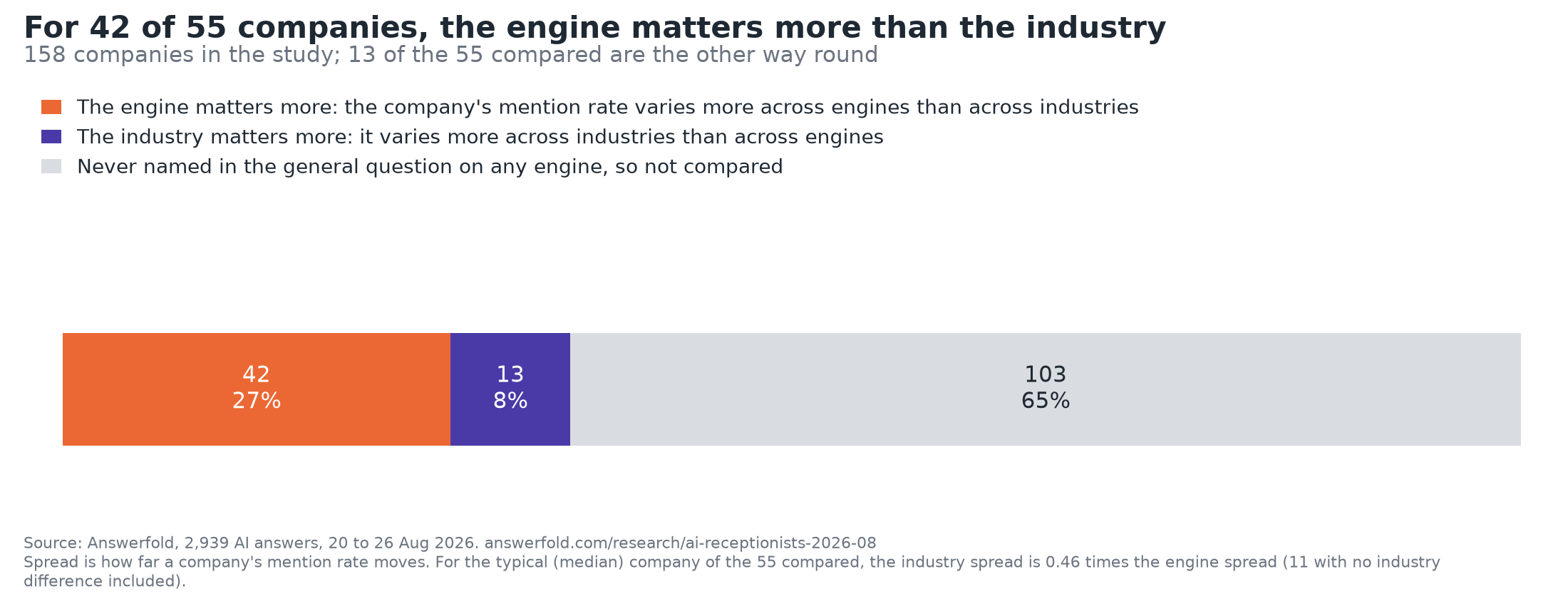
Of the 55 compared, 11 show no industry difference at all. They are still included.
Engine against industry, in average rates
This chart uses the 55 companies named in the general question on any engine, the same companies as above. The left panel changes only the engine: each bar is an engine on the same general question. The right panel changes only the industry: each engine has three bars, for dental (green), legal (yellow) and home services (pink), and the note beside them gives the gap between the highest and the lowest.
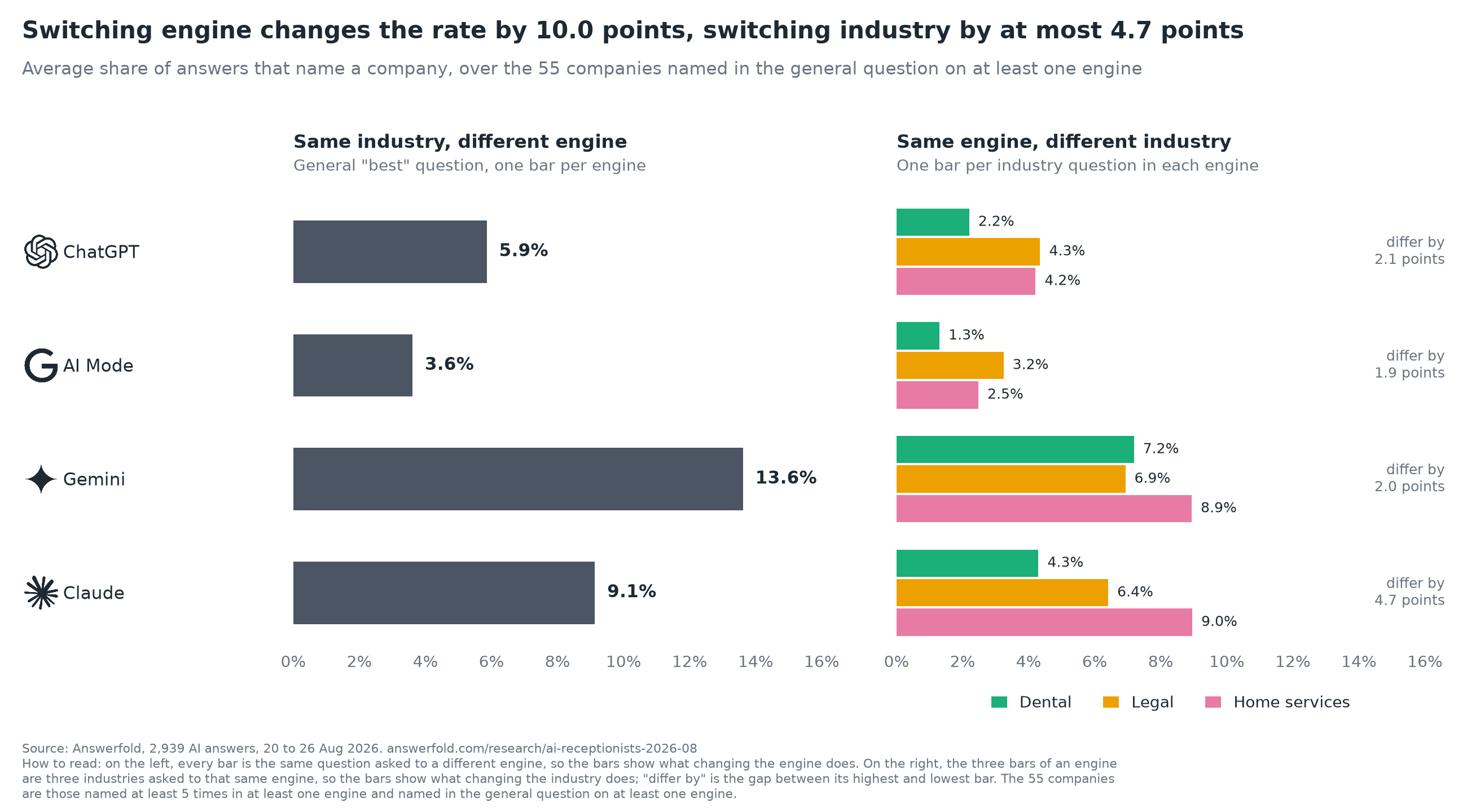
- Changing the engine moves the average rate by 10.0 percentage points, from AI Mode to Gemini.
- Changing the industry inside an engine moves it by less. The widest gap is 4.7 percentage points (in Claude).
Notes on the method
- Per-engine rates are averages over the 55 companies that were named at least 5 times by some engine and named in the general question by some engine, using usable runs of the unbranded questions.
- Spread is the standard deviation of a company's mention rate. The typical company is the median.
4. Answers that cite nothing, and mentions without the company's own citation
Which answers cite no source at all [S3]
Answers that cite no source at all range from 1.0% of answers in ChatGPT to 14.9% in Gemini, which is ahead of every other engine. In every engine most answers cite at least a page.
An answer is a usable run of a buyer question. A citation is a web page the engine attached as a source. Here we count the answers that attached no page at all: 7 of 735 in ChatGPT; 13 of 735 in AI Mode; 109 of 734 in Gemini; 12 of 735 in Claude.
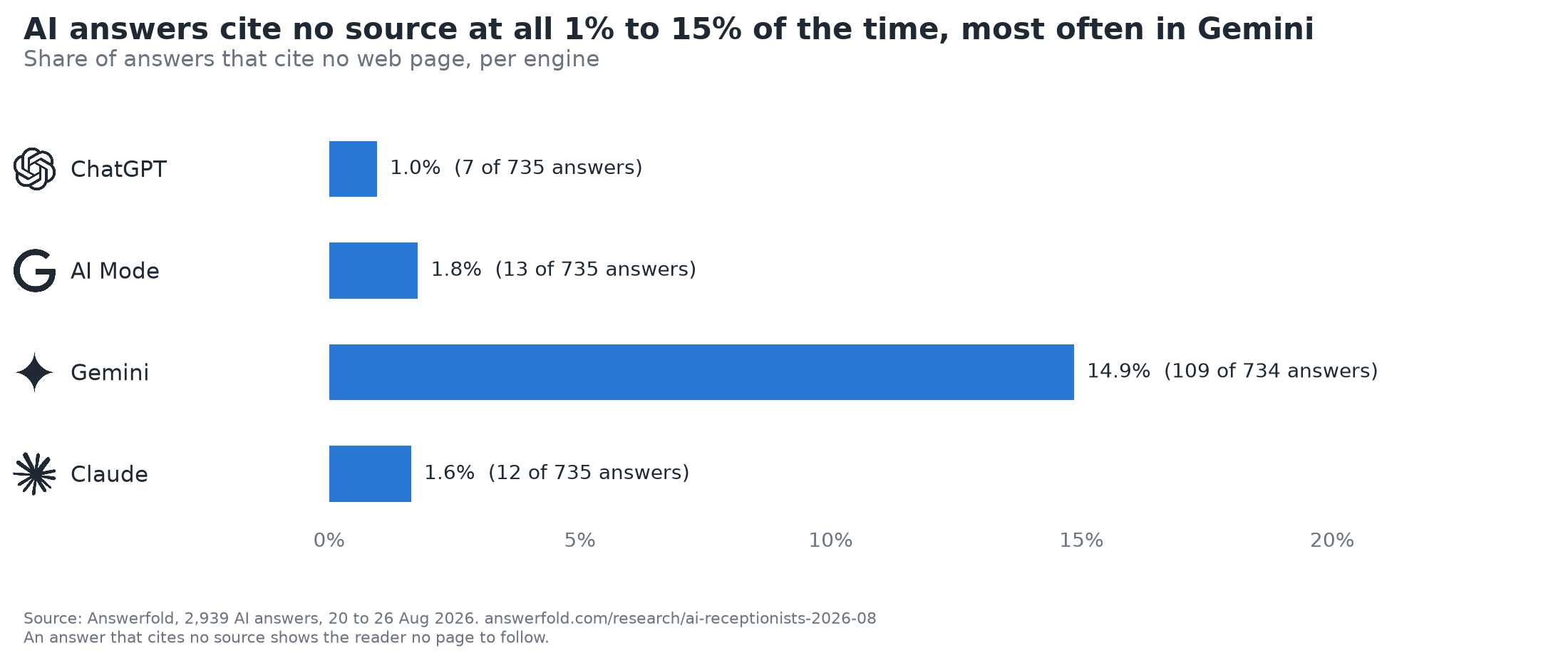
- Gemini has 109 answers that cite nothing. Across all four engines there are 141.
Notes on the method
- The share is counted over usable runs of all seven questions, including the question that names a company: 734 to 735 runs per engine.
- This is a descriptive table. We stated no expectation for it beforehand.
Company mentions where the company's own site is not cited [S2]
When a company is named, its own site is often not among the sources, and how often depends on the engine. In Gemini and Claude it is missing from about 2 in 3 of the mentions, with Gemini slightly higher. In AI Mode it is about 1 in 2, just under half. In ChatGPT it is about 1 in 6, the lowest.
A mention is a company named in an answer. For each mention we asked whether the same answer cited the company's own website. The main number counts only answers that cited any source ("restricted"). The other number also counts the answers that cited nothing ("all answers"). We also count the companies whose own website is cited in under 10% of their mentions in an engine.
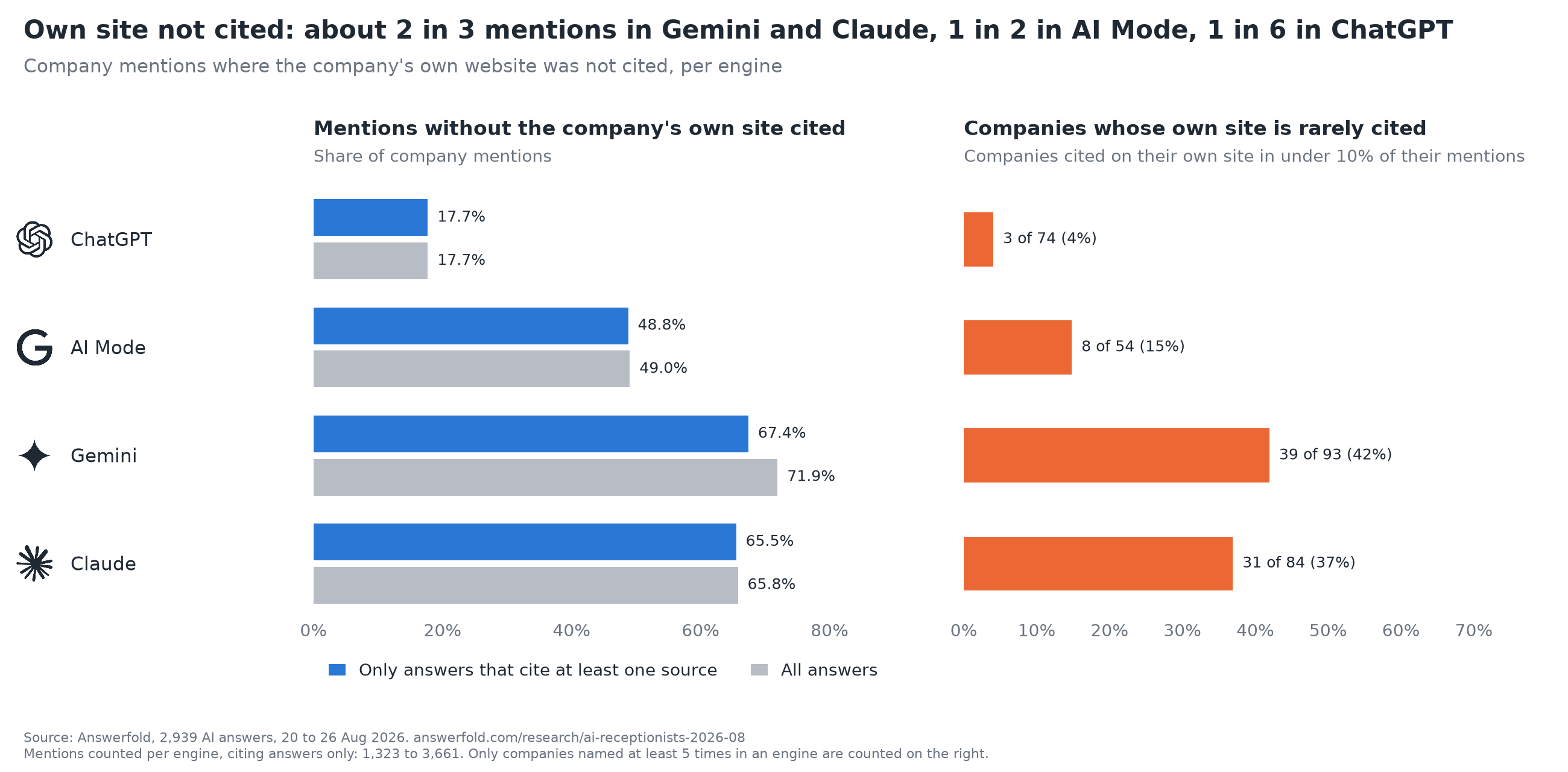
- Counting the answers that cite nothing never lowers the share. It moves it most in Gemini, the engine that cites nothing most often: from 67.4% to 71.9%.
- ChatGPT has both the lowest share of mentions without the company's own citation and the smallest share of companies whose own site is rarely cited. The largest share of such companies is in Gemini.
Notes on the method
- Mentions counted per engine, restricted to answers that cite a source: 1,323 to 3,661.
- Only companies named at least 5 times in an engine are counted on the right of the chart. No number is pooled across engines.
5. Who gets named, and whether that set holds
How concentrated company mentions are [K1]
In every engine a few companies take a large part of the mentions. The five most-named companies hold between 31% (Claude) and 44% (ChatGPT) of all company mentions, and between 8 and 11 companies reach half.
For each engine we ranked the companies by how often they were named. We then asked what share of all mentions the five most-named companies hold, and how many companies it takes to reach half of all mentions. As a comparison we show what the same five companies would hold if the engine had spread its mentions evenly over every company it named.
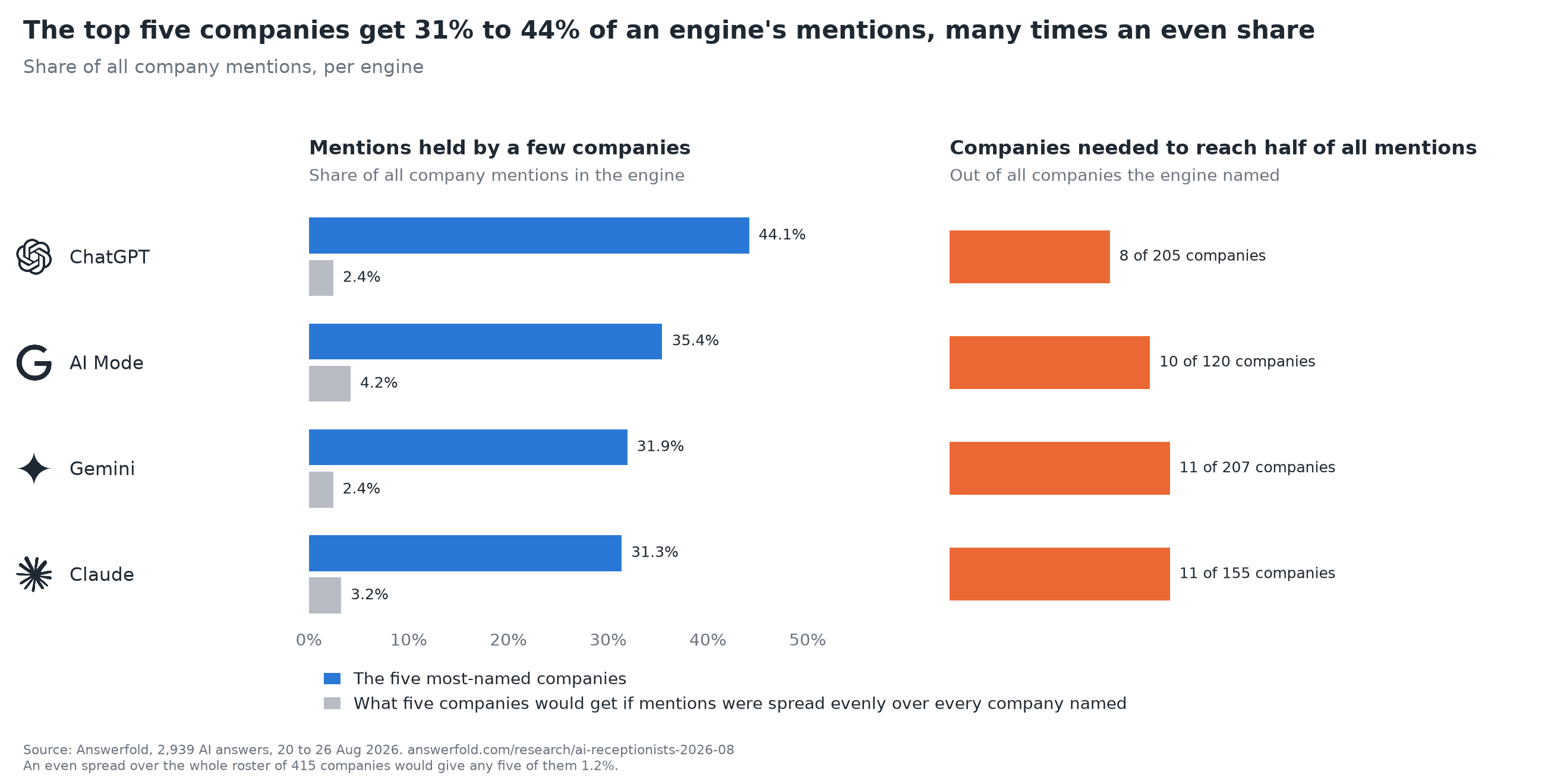
- ChatGPT is the most concentrated engine. ChatGPT needs the fewest companies, 8, to reach half.
- An even spread over the companies an engine named would give those five companies far less. The actual share is 8.5 to 18.1 times larger.
- Every engine also named companies outside our list of 415: 162 to 261 per engine. Of the companies on our list, Gemini named the most (207).
Notes on the method
- Counts are over company mentions in usable runs of the questions that do not name a company.
- The list of companies was built from the answers themselves and fixed after the study window closed (see Method).
Do the same companies get named day after day? [O1]
Only partly. The companies an AI engine names on a given day are only partly the same as on the day after. Even the 13 most-named companies of an engine overlap by 51% to 81% from day to day. A complete overlap would mean exactly the same companies on each day of a pair. This is the normal randomness of AI answers, not a trend: it is what chance alone would produce.
We predicted a steady top group with a changing tail. That did not appear in any engine. Only Gemini reaches the 80% line for a steady top group, at 80.5%, just at the line. Its tail overlaps 66%, above the 50% a changing tail would show.
For each engine we compared the companies named on a day with those named on the day after. Overlap is the companies named on both days divided by all companies named on either day. A company missing from either day lowers the overlap. The top group is the engine's 13 most-named companies. The tail is the less-named half of the companies the engine named. Each engine has a blue bar for the top group and a grey bar for the tail. The dashed lines mark the overlap a steady top group and a changing tail would show.
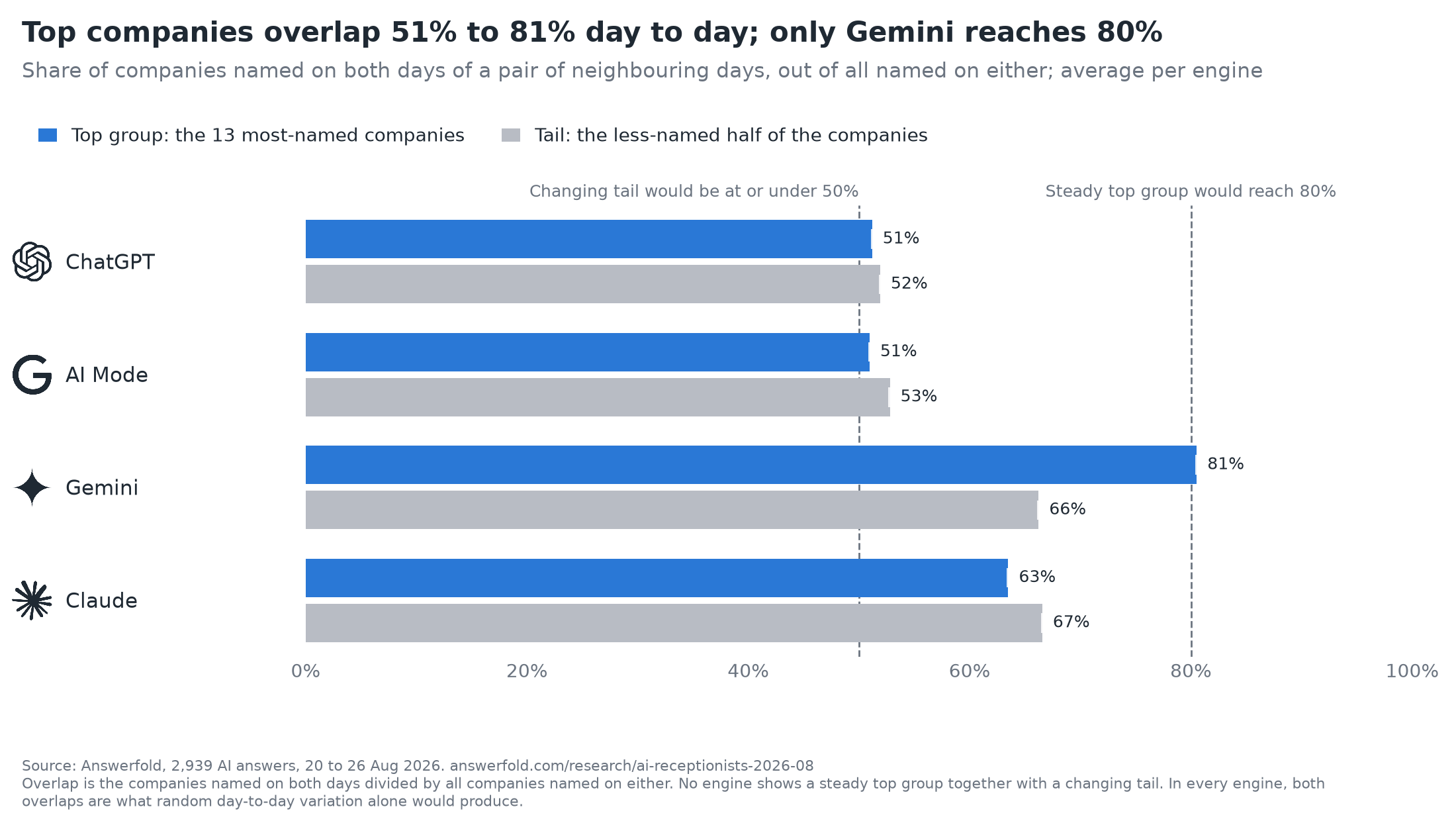
- AI Mode is the least stable, with 51% for the top group.
- In one of the four engines the top group overlaps more than the tail. In the others it does not. A steady top group together with a changing tail appears in zero of the four.
- In every engine, both overlaps are in line with what random day-to-day variation alone would produce, so the changes are not a trend.
Notes on the method
- The tail is the bottom half of the companies that qualify in that engine (the number that qualify is given in Method).
- "What noise alone would produce" comes from comparing the observed overlap with overlaps from runs that differ only by random variation.
6. Which domains get cited
Does a short list of sites decide what AI engines cite? [K2]
No. Citations are spread out, and no short list of sites carries an engine. The ten most-cited sites of an engine get 38% to 46% of all its citations, and the many other sites share the rest. The share stays below 60% however we count.
A citation is a source link an AI engine shows with its answer. For each engine we took its ten most-cited sites and asked what share of all its citations they receive. When that share is high, the citations are concentrated on a few sites. We counted three ways, from the main view to the strictest:
- Every citation counted. This is the main view.
- Without the citations of a named company's own site (the pages you can act on).
- Without the sites of all companies on our list, which shows what the other sites receive.
Reference levels help to read the result. At 60% or more, a short list of sites would be worth treating as a target list. Below 40%, there is no such short list. They describe the result. They are not a pass or fail mark. Each engine has three bars in shades of blue, and the darkest is the main view.
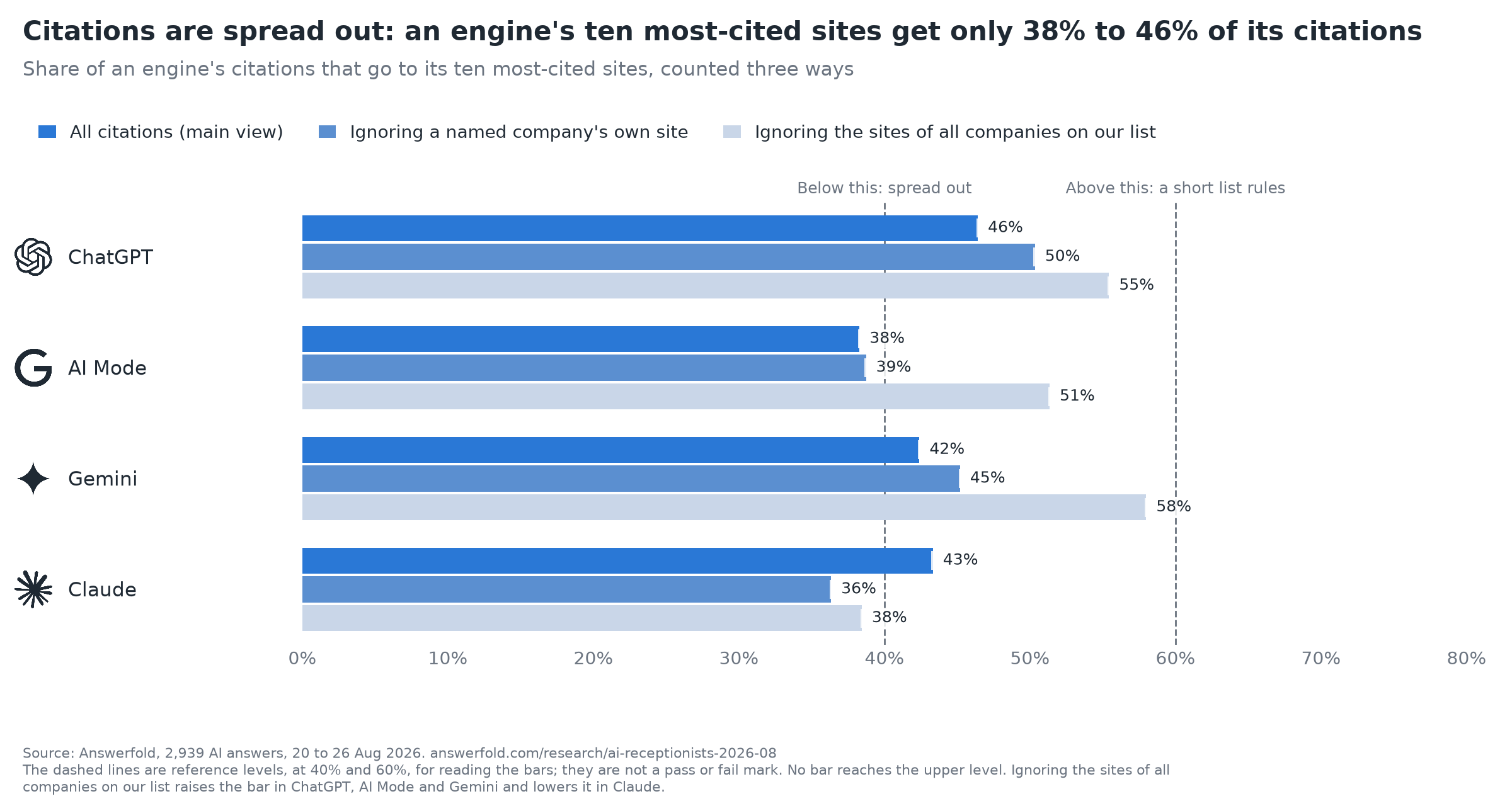
- In the main view ChatGPT is the highest. Only AI Mode is below 40%, so its citations are the most spread out. The other engines sit between the reference levels. No engine reaches 60% in any of the three views.
- Without the sites of all companies on our list, the share of the most-cited sites goes up in ChatGPT, AI Mode and Gemini. It goes down in Claude.
- Across all engines together it takes 25 sites to reach half of all citations, more than in any engine alone (13 to 20).
Notes on the method
- The reference levels describe how concentrated the citations are. They are not used to pass or fail a claim.
- Citations are counted over usable runs of the questions that do not name a company. The counts behind each bar are in the stored results.
7. Drift against noise, then shared drift
Whether companies drift from day to day beyond noise [V2]
The typical company does not drift: the median change in mention rate is 0.0 percentage points in every engine. Only 0.9% to 2.4% of cases change enough to be worth an alert. In three of the four engines that small share is more than random noise alone would produce.
A case is a company asked about in a question wording. For each case we measured how much its mention rate changes from day to day beyond the normal run-to-run variation, in percentage points. A change of at least 5.0 percentage points is worth an alert. To see whether the cases that pass this line are real or just noise, we compared their share with the share produced when only random noise is present. Each engine has a blue bar for the share of cases worth an alert and a grey bar for the share that noise alone would give.
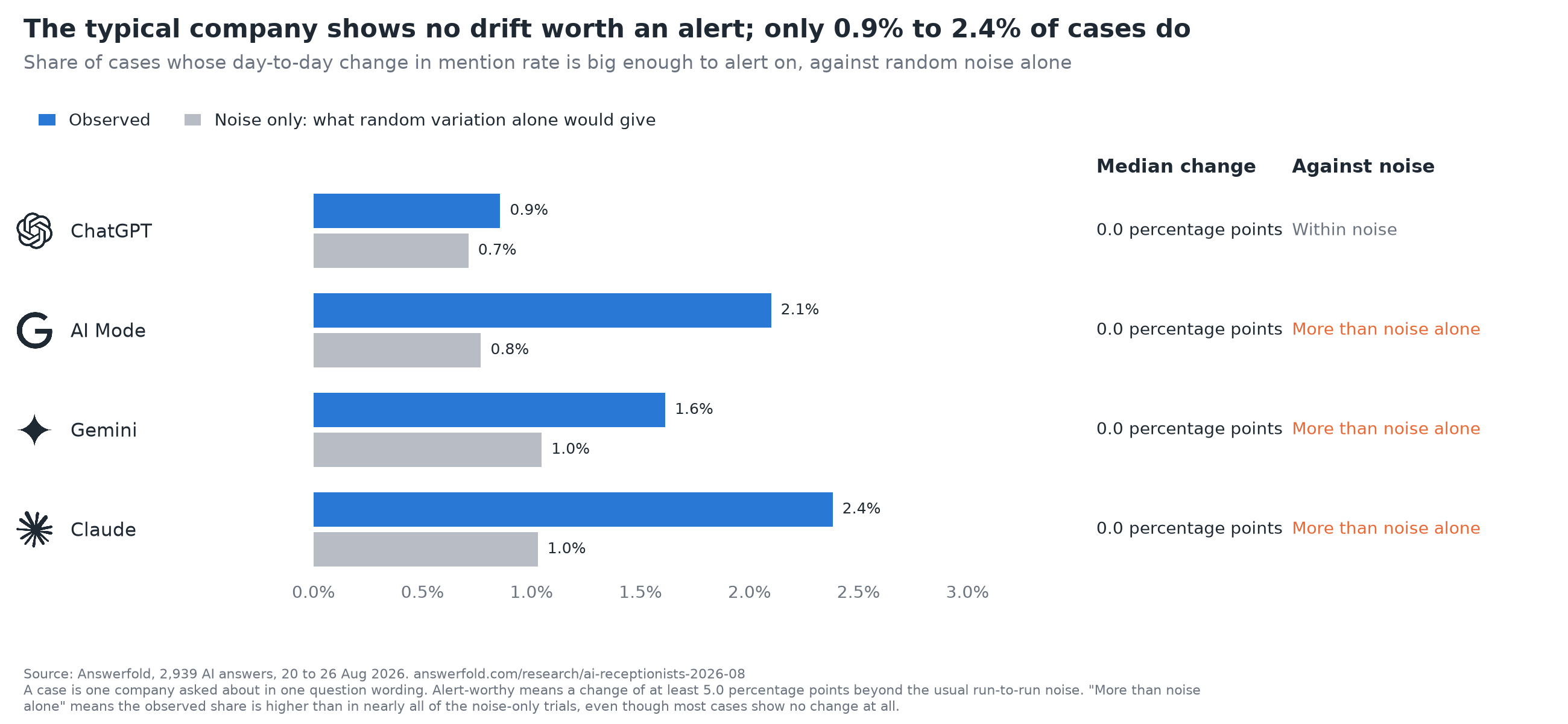
- The observed share is above the noise-only share in every engine. It is more than noise alone in three engines, and only ChatGPT is in line with noise.
- Most cases do not change at all: between 78% and 84% of cases show no change on any day. That is why even the noise-only share is small, and why a small observed share can still be more than noise.
Notes on the method
- Cases counted per engine: 1,620 to 2,790. The median is a median over cases, so a few companies that move a lot do not show in it.
- "More than noise alone" means the observed share is higher than in nearly all of the noise-only trials.
Whether engines drift together [A2]
The engines do not move together. The average correlation between pairs of engines' day-to-day changes in company mentions is -0.07, and no pair reaches 0.3, the level at which we would say that something shared is moving.
For each pair of engines we correlated their day-to-day changes in how often companies are named. A correlation near zero means no relationship, a positive correlation means the engines move together, and a negative correlation means they move in opposite directions. Each row of the chart is a pair of engines. The dot is the correlation and the line is its 95% interval. Purple means the interval excludes zero, grey that it includes zero. There are six pairs of engines.
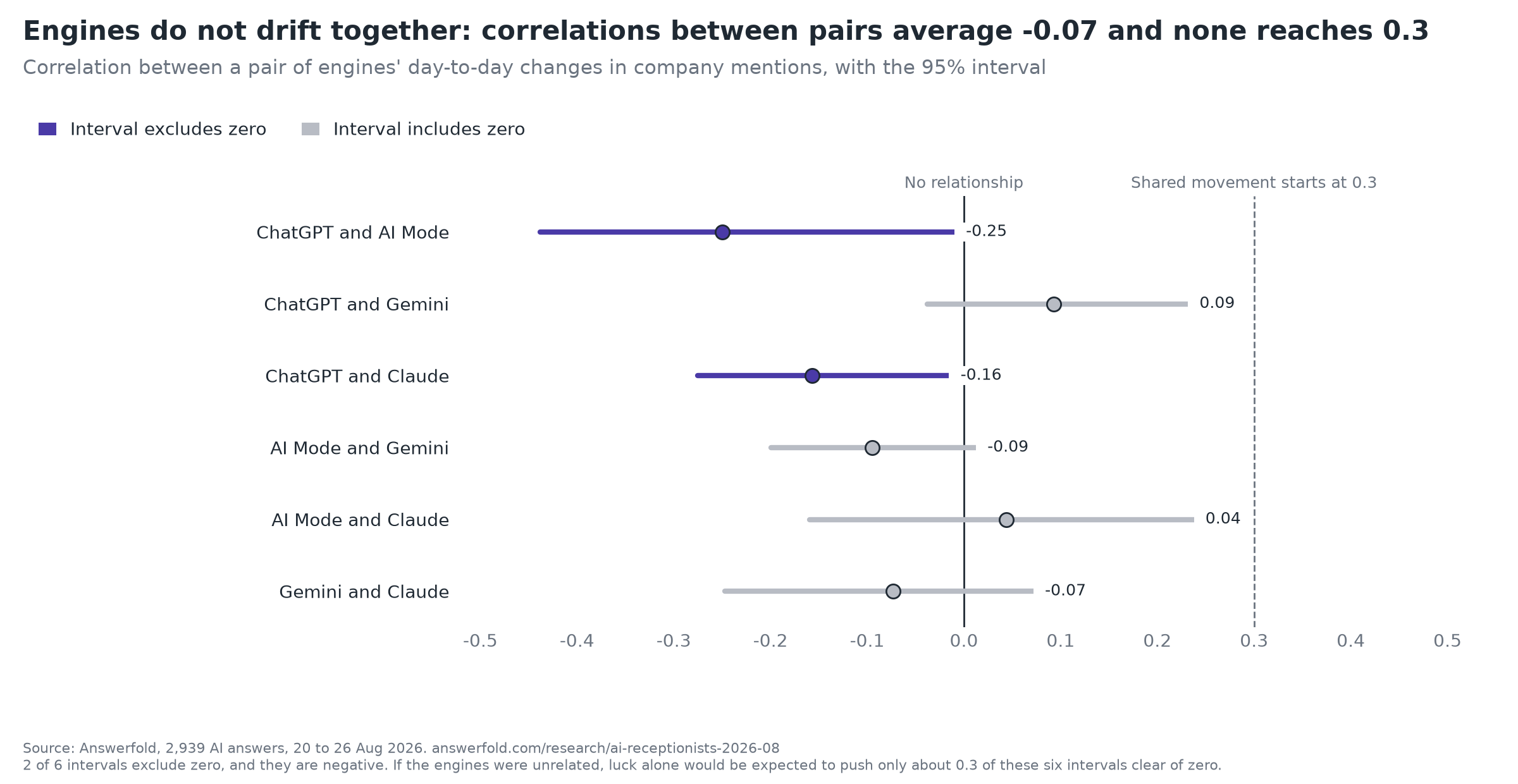
- The correlations run from -0.25 to 0.09, all below 0.3.
- For four of the six pairs the interval includes zero, so there is no clear relationship. Of the six correlations, four are negative.
- The two intervals that exclude zero are negative, which means those engines tend to move in opposite directions, not together.
Notes on the method
- The interval comes from resampling companies. All six pairs were examined, so luck alone would be expected to push about 0.3 of the intervals clear of zero.
Does a change-detection product exist?
Not on this evidence. A service that alerts a company when its visibility in AI answers changes would have little to alert on for the typical company, and the study found no sign of a shared, category-wide movement.
- The typical company shows no drift worth an alert in any of the four engines (the median change is 0.0 percentage points).
- The engines do not drift together: the average correlation between pairs is -0.07, so there is no sign that a category-wide alert would work either.
- A small group of cases drifts more than noise alone would produce, in three of the four engines. That is a reason to look further, not a product.
8. Further views, looked at after the data was in
Everything in this section was produced after we had seen the data, not planned beforehand. Read it as leads, not as tested results.
Whether the most-mentioned companies are also the most-recommended [A3]
In every engine the companies mentioned most are also recommended most: the rank correlation is 0.98 to 0.99. Only 7 company-and-engine combinations across the four engines are recommended far below their mention rank.
For each engine we ranked the companies by how often they are mentioned and, separately, by how often they are recommended. The rank correlation says how closely these rankings agree. A gap of 10 places is where we flag a company as recommended far below its mention rank. In the chart, the left panel (blue) shows the rank correlation per engine, and the right panel (orange) counts the flagged companies.
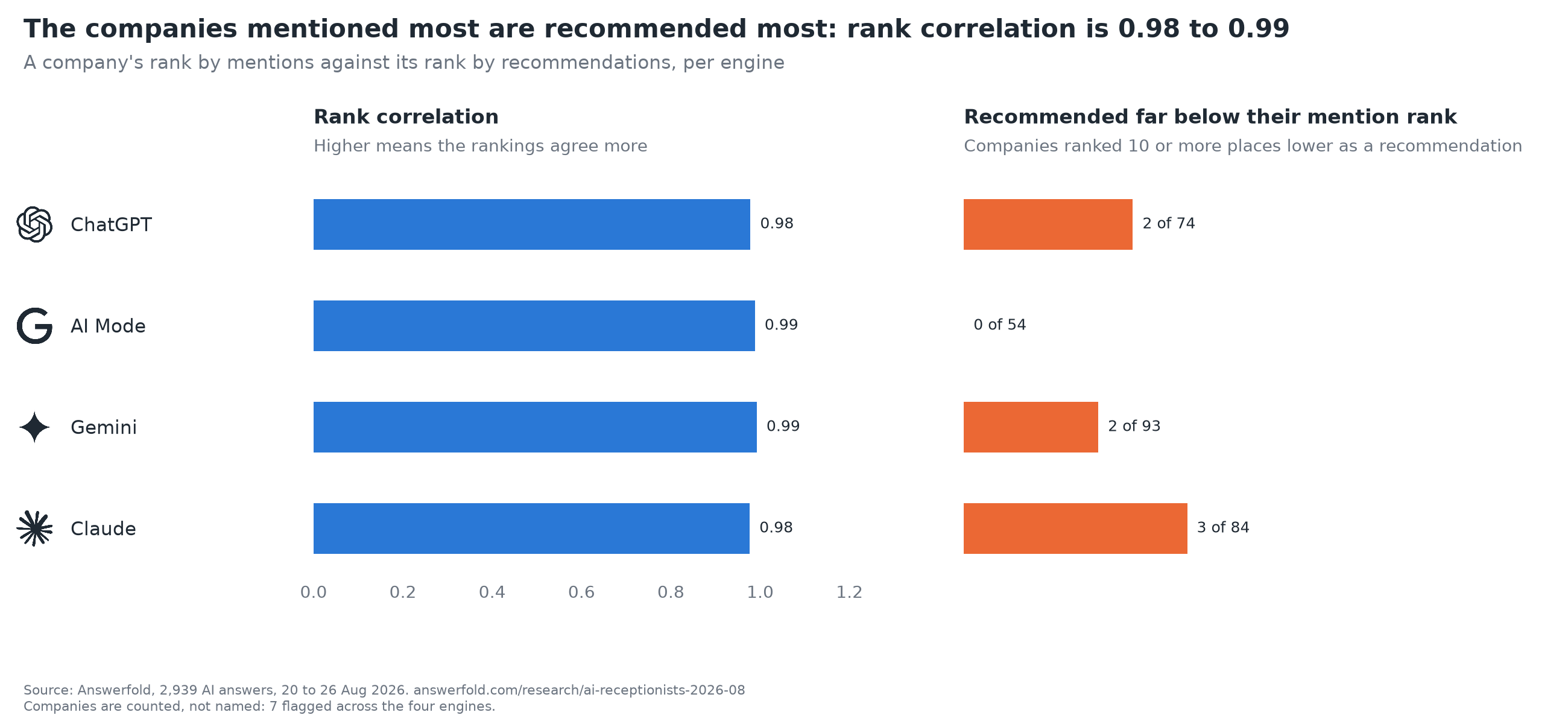
- AI Mode flags no company at all, and three of the four engines flag some.
- Ties in the ranks cannot by themselves produce a gap of 10 places in any engine.
Notes on the method
- Only companies that qualify in an engine (named at least 5 times) are ranked.
Rewording a question against asking it again [O2]
Rewording a question changes which companies are named more than asking the same question again. The overlap between answers to different wordings is 0.22 against 0.35 for repeats of the same wording, and this holds in every engine.
For a pair of answers, overlap is the companies named in both divided by all companies named in either. We compared pairs of both kinds: the same question in different wordings, and the same wording asked again. Each question had five wordings, and each wording was run three times a day. Each engine has an orange bar for reworded questions and a grey bar for repeats. The bottom row pools all engines and gives the difference with its interval.
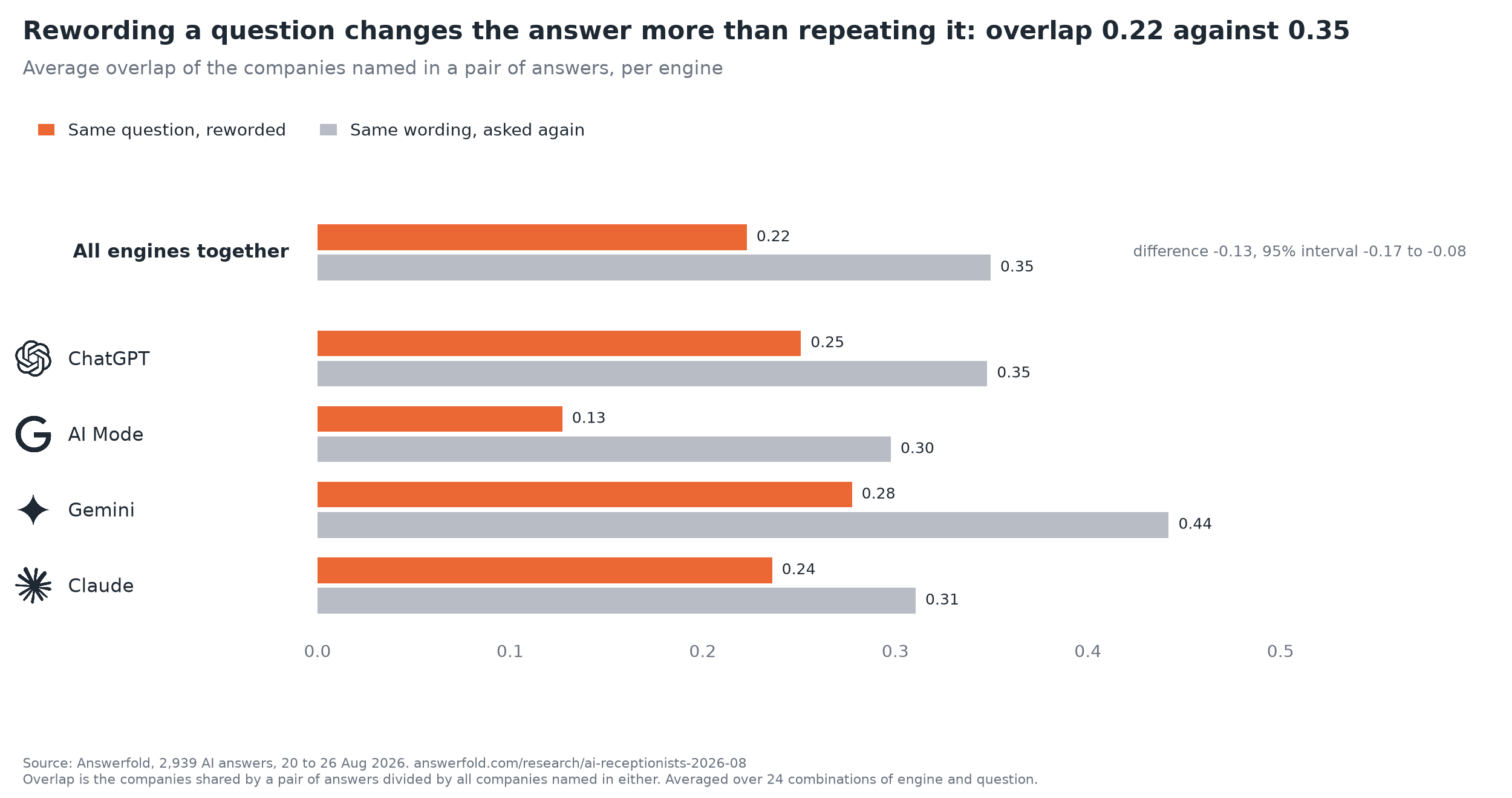
- Pooled over all engines the difference is -0.13, with a 95% interval from -0.17 to -0.08. The interval lies entirely below zero.
- In 20 of 24 combinations of engine and question the reworded overlap is lower than the repeat overlap.
Notes on the method
- Averaged over 24 combinations of engine and question, with five wordings per question.
The type of page each engine cites most [X1]
In every engine the most-cited type of page is vendor content, but not the same type everywhere: vendor page in ChatGPT; vendor page in AI Mode; vendor listicle in Gemini; vendor listicle in Claude.
Our classifier labels each cited vendor page, for example as a product page or a comparison article ("listicle") on a vendor's own site. For each engine we found the label that covers the largest share of its citations. Each bar is an engine, its length is the share of the engine's citations that go to its most common page type, and the colour says which type (blue for vendor product pages, orange for vendor listicles). These are the classifier's raw labels, so the shares differ from the vendor-published share in the question on who writes what AI search cites.
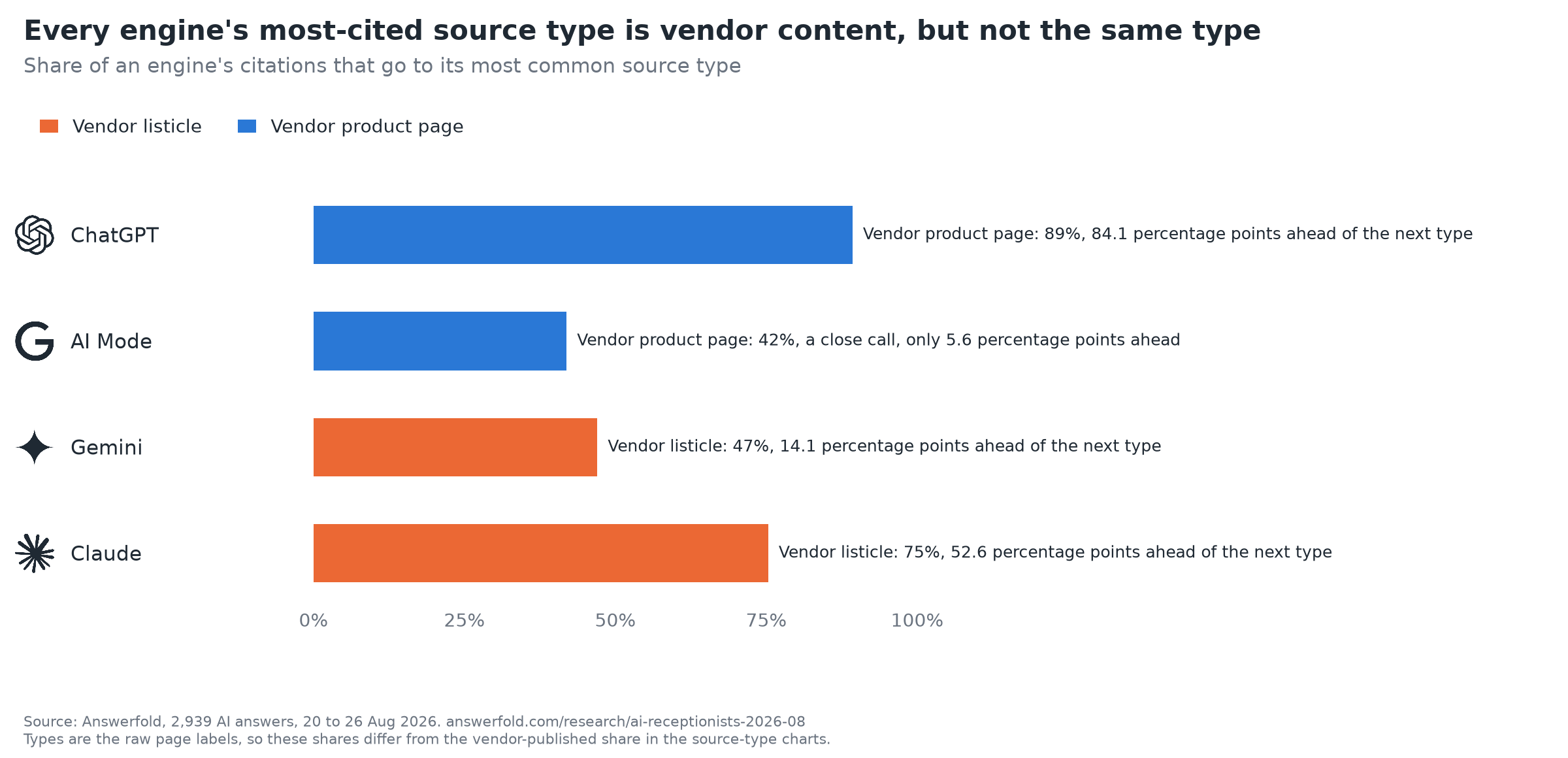
- In ChatGPT the lead is clear (84% of citations ahead of the next type). In AI Mode it is a close call: the lead is only 6% of citations.
- Vendor product pages are 89% of citations in ChatGPT, and vendor listicles are 75% in Claude.
- Together, vendor product pages and vendor listicles are 78% to 98% of citations.
Notes on the method
- 308 citations whose page type could not be classified are left out.
Runs where the engine did not search the web [S4]
Engines mostly search the web before answering, but not always. The share of runs answered without a search is 0.0% in AI Mode and 14.9% in Gemini, which skips more than any other engine.
When an engine does not search, its answer comes from memory only, with no fresh pages to cite. We counted the usable runs in which the engine did not search: 7 of 735 in ChatGPT; 0 of 735 in AI Mode; 109 of 734 in Gemini; 12 of 735 in Claude. The left panel of the chart (blue) shows the share of runs answered without a search for each engine. The right panel (orange) zooms into Gemini and a particular question wording, by question.
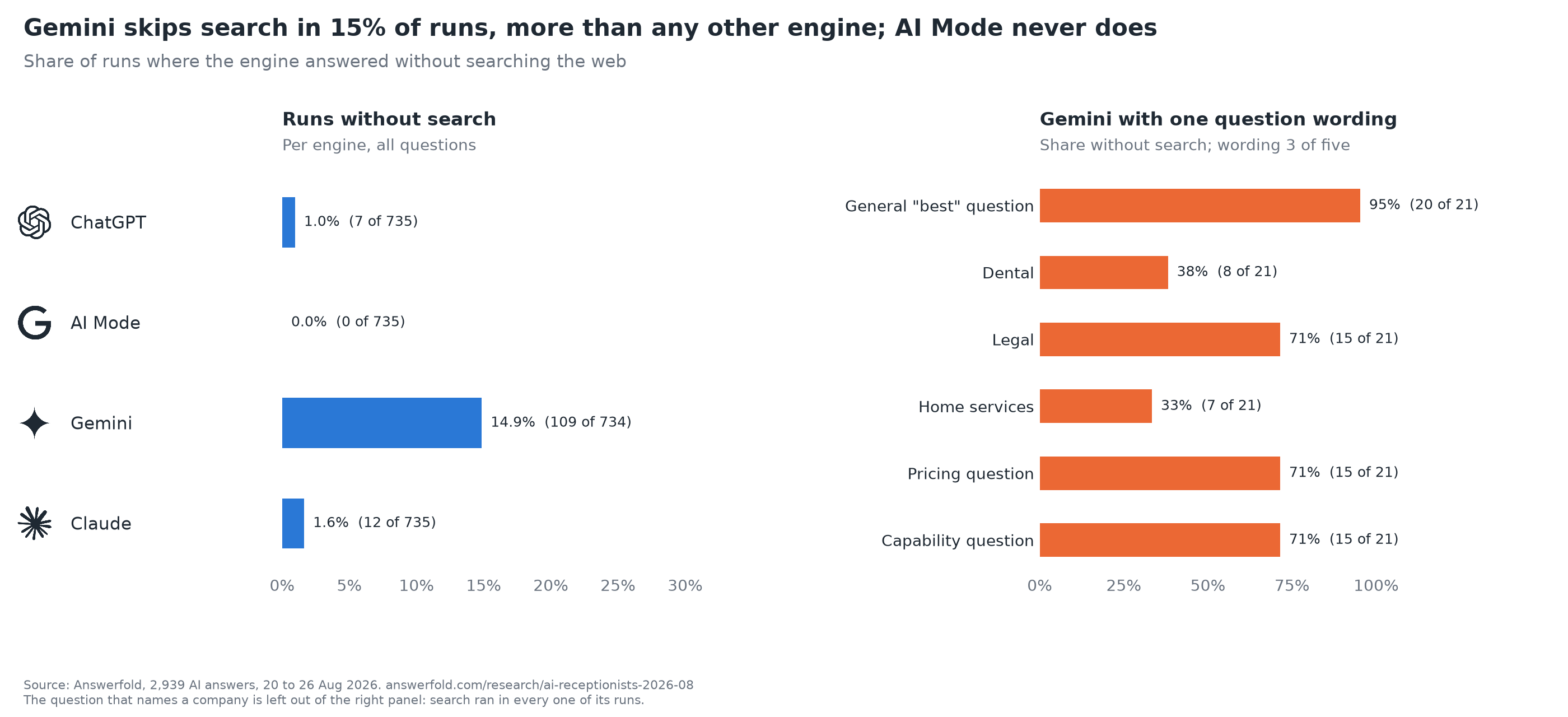
- AI Mode never skipped a search, while each of the other three engines skipped it in some runs. Across all engines 128 runs had no search.
- In every engine that skipped searches, the runs without a search cite no source.
Notes on the method
- A run counts as skipped when the stored record shows no search. The share is over usable runs of all questions.
Gemini: a question wording that skips search most
In Gemini, a particular wording of the questions (wording 3 of five) skips the search in 63% of runs on average across the six questions that do not name a company, against at most 8% for any other wording. The right panel of the chart above shows it by question.
- It skips the search for every question that does not name a company, in 33% to 95% of runs, and in more than half of the runs for four of the six questions.
- For each question it skips more often than any other wording of that question.
- For the question that names a company, it never skips the search.
Notes on the method
- We noticed this pattern by looking at the data after collection. A planned analysis did not find it, so treat it as a lead.
- Each question has 21 usable runs for this wording, so each rate is rough.
- With no search, the answer comes from the model's memory only, so its mention rates for these runs are not comparable with the rest.
How many searches the engines ran
The section on mentions without the company's own citation says the search fan-out likely explains the gap. We read the search queries stored with each answer after the data was in. ChatGPT ran 7.1 searches per answer, Gemini ran 1.6 and Claude ran 1.9. In ChatGPT, 53% of the searches were limited to a vendor's own domain (2,808 of 5,251). AI Mode does not keep its searches, so it is not counted. We did not test whether this explains the gap, so read it as a lead.
Source: the search queries stored in the record of each answer, over 735 answers in ChatGPT, 734 in Gemini and 735 in Claude.
Conclusion
So what does it show? Mostly that there is a lot of leverage. In this market AI answers are built mostly from pages vendors write about themselves and about each other, 74% to 91% of the citations, and half of all mentions go to just 8 to 11 companies in each engine. In Gemini and Claude a company is usually named without its own site among the sources, so what others write about you matters as much as what you write yourself. All of these pages can be written and changed, that's why I think the room to move is big. Still, I have to be honest, this is correlation, I didn't test what happens when a company actually changes something.
It also slightly differs from the main SEO and GEO advice. Google says GEO is still SEO, and partly the data agrees: companies in Google's top ten get named 3.3 to 6.8 times as often. But a lot of the usual tips, like getting reviews or being on Reddit, don't show up much here, at least in this market. Review sites are 0.8% of citations or less and Reddit is 3.8% or less. And the engine you ask matters more than the industry, so each engine needs to be checked on its own, and classic SEO advice doesn't really cover that.
For now it's hard to track what GEO actually brings in money. AI sends only a small part of website traffic, and studies give quite different numbers, 0.32% of visits in one and about 1% in another, but that share keeps growing every year. So further research is needed, especially tests where a company changes something and we measure before and after, to know which changes are really worth it for business.
If you have feedback, found a mistake, want to cooperate, or want to know how your market looks, write me at danylo@answerfold.com. I also do per company breakdowns: how your company shows up in each engine, which pages AI reads when it names your competitors, and a plan to improve your visibility based on what the most named companies in your market do.
What I built on
- GEO itself, the idea that AI answers can be measured and influenced: Aggarwal et al., GEO: Generative Engine Optimization, KDD 2024.
- Counting how often a company is named, not its rank, because the same question almost never gets the same list twice: Rand Fishkin (SparkToro) and Patrick O'Donnell (Gumshoe), research on AI answer consistency, January 2026.
- 5 wordings for every question: Jack, Lehman, Maloney and Xu, Paraphrase Brittleness in Production Retrieval-Augmented Commercial Recommendation, 2026. The summary page shows the same thing here: rewording changes the answer more than asking again.
- Spending runs on wordings, not on repeats: Zatuchin, Where Does the Noise Come From?, 2026.
- 3 runs a day for 7 days, to tell run-to-run noise apart from real day-to-day change. Schulte, Bleeker and Kaufmann (Don't Measure Once, 2026) suggest at least 7 runs of a prompt per day. I did 3 per wording, because the two papers above suggest that extra wordings help more than extra repeats.
- Plan and predictions written before the data: borrowed from pre-registration in science, Nosek et al., The preregistration revolution, PNAS 2018. Mine is a lighter version.
- Query fan-out, the extra searches an engine runs behind one question: Google's own term, explained in its guide on AI search.
- Overlap between answers: the Jaccard index, companies named in both answers divided by companies named in either.
Several of these come from people who work at companies in the AI visibility business (Gumshoe, Unusual, Rankfor.AI, Aurora Intelligence). So do I, with Answerfold, so read all of us with that in mind.
Questions about the data? danylo@answerfold.com